
Fluidized Zone Mixers: The “Hidden Champion” of Pharma Solid Dosage Equipment
After digging through Quora and Reddit discussions about pharma equipment, I noticed something interesting. Everyone talks about tablet pressing and coating processes. But mixing? Hardly anyone pays attention to this seemingly boring step. Then a Pfizer engineer with 15 years’ experience posted on r/PharmaceuticalTechnology: “70% of our batch failures traced back to the mixer.”
That’s when it hit me. Fluidized Zone Mixers might be the most underrated equipment in solid dosage manufacturing.
Why Does Pharma Have a Love-Hate Relationship with Mixers?
There’s a popular Quora question: “Why is pharmaceutical powder mixing so challenging?” A former Novartis formulation scientist gave a brutally honest answer:
“Because we’re forcing materials that hate each other to mix.”
He explained that API (Active Pharmaceutical Ingredient) might be just 0.5%. The rest is excipients. Imagine spreading one spoonful of salt evenly through a ton of flour. Every tablet must have exactly that amount. Over 5% deviation? FDA shuts you down.
Reddit’s r/ChemicalEngineering gets more blunt:
- Different particle sizes cause segregation (like cereal boxes after shaking)
- Static electricity makes powders clump
- Mix too long and you get “reverse segregation”
- Mix too little and drug potency varies
Traditional V-blenders and double-cone mixers start showing their limits here.
How Do Fluidized Zone Mixers Solve These Problems?
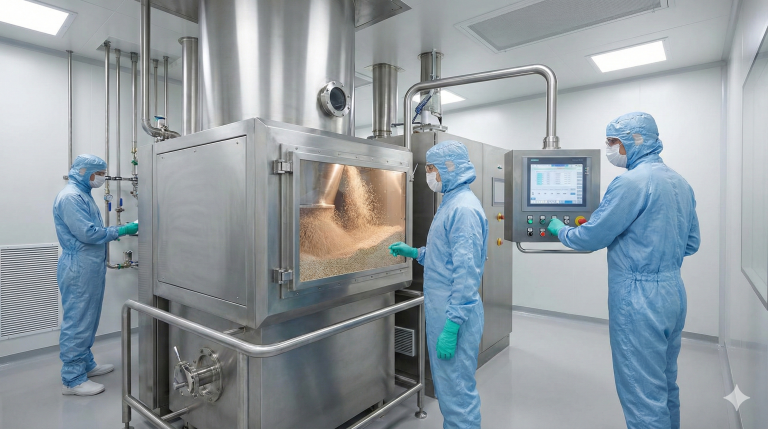
Let’s talk about how they work. Simply put, they don’t rely on mechanical stirring. They use airflow to “lift” and mix powders.
Found a great analogy on Quora from a Solid Dosage Equipment Manufacturer’s technical director:
“Traditional mixers are like stirring a pot of soup. Fluidized zone mixers? Think of them as a tornado in a bottle.”
In plain English: Traditional mixers are like stir-frying. You might burn one side. Fluidized zone mixers are like tornadoes. Powders tumble in airflow. Contact is more uniform.
Real User Feedback from Reddit
On r/Manufacturing, there’s a thread comparing different Pharmaceutical Mixing Machines. One guy shared his factory’s data:
After switching to fluidized zone mixers:
- Mixing time dropped from 45 to 15 minutes
- Content uniformity RSD fell from 8% to 2.3%
- Most importantly: Cleaning time reduced by 60% (no dead corners or complex agitators)
But he also complained: “Equipment costs a fortune. Demands skilled operators. Poor pressure control makes mixing worse.”
This reminded me of a Quora discussion: Is it worth investing in advanced mixing technology?
Top answer was practical:
- Generic drugs with large batches? Traditional mixers work fine
- Innovative drugs, small batches, or ultra-low API content? Fluidized zone mixers are essential
- Got FDA warnings for mixing issues? Stop hesitating. Upgrade now.
Technical Details: When Must You Use Fluidized Zone Mixing?
Compiled scenarios repeatedly mentioned on Quora and Reddit:
1. Low-Dose High-Potency Drugs
A pharmacist on Reddit gave an example. A blood pressure medication had 0.02% API. Regular mixers couldn’t achieve uniformity. After switching to fluidized zone mixers? 100 batches passed inspection.
2. Powder Combinations Prone to Segregation
Someone on Quora asked: How to prevent segregation in tablet manufacturing?
An engineer from an Indian Pharmaceutical Mixing Machine supplier answered:
“Fluidized mixing doesn’t just mix—it actively fights segregation. Particles suspended in air make density differences matter less.”
3. Formulations Requiring Coating or Granulation
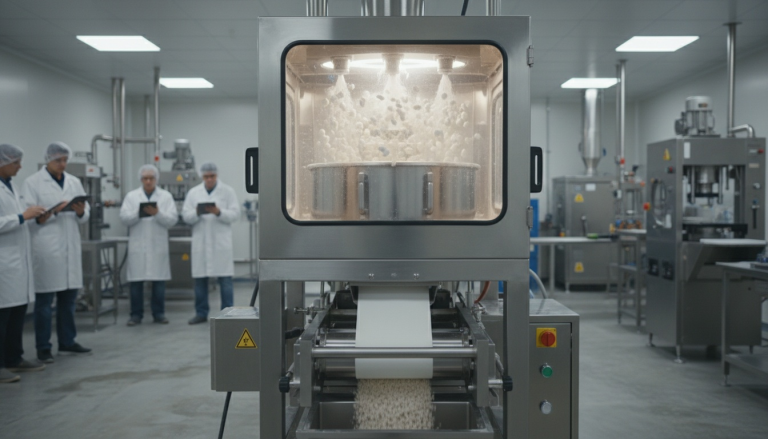
Fluidized zone mixers have a cool trick: mix while spraying liquid. This means:
- Granulation and mixing in one step
- Less material transfer (lower contamination risk)
- Saves time and equipment investment
But They’re Not Perfect
Reddit has a complaint post: “Bought a $500K fluidized mixer, regret it”
What went wrong?
- Not suitable for sticky materials: Airflow can’t lift them. They stick to walls instead
- Large particle size differences don’t work: Mixing powder with granules? Light particles blow to the top
- High maintenance costs: Filter systems and pressure controls are wear items
Great reply: “It’s a Ferrari—amazing performance, but you better have a good mechanic.”
Buying Tips: Hard-Earned Lessons from Practitioners
Compiled from Quora and Reddit discussions, here’s how to avoid pitfalls:
Find Reliable Solid Dosage Equipment Manufacturers
- ✅ Must have GMP certification and validation services (full IQ/OQ/PQ suite)
- ✅ Can provide trial batch services (test your formulation, don’t just look at specs)
- ✅ Fast local service response (equipment downtime costs hundreds of thousands daily)
Reddit user advice: “Visit their facility. If they can’t show you a working demo unit, walk away.”
Don’t Just Look at Price
Quora question: Why are pharmaceutical mixers so expensive?
Equipment sales manager’s honest answer:
- Material costs: 316L stainless steel plus mirror polishing
- Compliance costs: Every part needs material certification and cleaning validation
- R&D costs: Extensive DOE (Design of Experiments) for parameter optimization
But he added: “A good mixer pays for itself in 2 years through reduced batch failures.”
Future Trends: Will AI Replace Mixing Engineers?
Recently saw an interesting Reddit discussion. A startup is developing “AI-optimized fluidized mixing.”
The principle:
- Sensors monitor powder flow in real-time
- AI algorithms dynamically adjust airflow speed and direction
- Claims to reduce mixing time by another 30%
Comments exploded:
- Excited: “Finally, mixing becomes a data science problem!”
- Skeptical: “Will FDA approve black-box algorithms controlling critical processes?”
- Realistic: “Sounds cool, but our facility doesn’t even allow equipment online…”
My take? Technology always progresses. But pharma’s conservatism isn’t bad—lives are at stake. Fluidized Zone Mixers work since the 1980s. Not because of hype. Because they solve real problems.
Final thoughts: If you’re struggling with mixing uniformity, or auditors found mixing-related deviations, don’t blame operators. Check if your mixing equipment needs upgrading.
In pharma, “close enough” and “perfectly uniform” differ by millions in recall costs.
Think about it.