
IBC Container Blenders: The “Lego-Style” Mixing Revolution in Pharma
I’ll be real with you. When I first saw IBC Container Blenders in a production facility, I thought it was just an oversized coffee roaster. Then an engineer told me, “This thing mixes 1000 liters of powder at once. Precision hits CV≤5%.” That’s when it hit me. This wasn’t just a mixer. It was a pharmaceutical factory’s “Transformer.”
Why Are Pharma Companies Going Crazy for IBC Systems?
I spent hours on Quora browsing pharmaceutical equipment discussions. One answer really stuck with me: “Traditional mixers are like dumping all ingredients into a wok to stir-fry. IBC systems? You just swap out the entire wok. The ingredients stay in their original container.”
That comparison nails it.
The “Disaster Scene” of Traditional Mixing
On Reddit’s r/pharmaceuticalindustry board, one guy complained about their factory’s mixing process:
- Manual shoveling into hoppers (dust flying, API exposure)
- Manual discharge after mixing (another dust nightmare)
- Four hours of disassembly and cleaning between product changes
- Worst part: One batch of raw materials gets transferred between 3-4 different containers
His exact words: “Feels like I’m not making medicine. I’m moving bricks. Every equipment cleaning makes me want to quit.”
This reminded me of what a Solid Dosage Equipment Manufacturer sales director once told me: “Before the 2010s, pharma mixing workshops were basically ‘dust explosion prep teams.’ Operators inhaled more API daily than patients took in a year.”
Scary when you think about it.
How Does IBC Achieve “Plug and Play”?
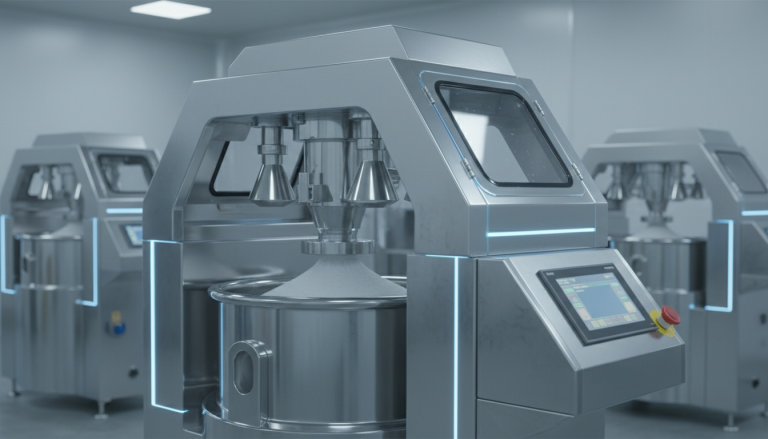
The core logic is simple: Separate the mixing container from the mixing action.
Picture this:
- You have 10 standardized IBC containers (Intermediate Bulk Containers)
- Each container directly interfaces with the mixer host
- During mixing, the container locks onto the host and rotates/tumbles
- After mixing, the whole container detaches and moves to the next process
A process engineer on Quora summed it up perfectly:
“IBC systems essentially transform ‘product flow’ into ‘container flow.’ The material doesn’t move. What moves is what holds the material.”
Real User Experience: Reddit Users Speak Out
On r/biotech, I saw a post where someone shared changes after upgrading from traditional V-blenders to IBC Blenders:
Time Costs:
- Product changeover cleaning: from 4 hours → 30 minutes (just simple container wall rinsing)
- Single batch mixing time: from 45 minutes → 20 minutes
- “We now run 6 batches daily. Used to max out at 3.”
Labor Costs:
- Operators reduced from 4 → 2 people
- “Key thing: no one enters confined spaces to shovel material anymore. Safety hazards dropped to zero.”
Quality Stability:
A top-voted reply mentioned: “We ran comparison tests. Same formulation. Traditional mixers had batch-to-batch CV fluctuating 8%-12%. IBC systems stayed stable at 3%-5%. FDA auditors literally praised us when they saw the data.”
But—IBC Isn’t a Magic Bullet
Reddit also has plenty of “failure” cases.
Pain Point One: Initial Investment Hurts
A small pharma business owner complained on r/smallbusiness:
- One IBC Blender host: $200,000-$400,000
- Each IBC container: $10,000-$30,000
- Supporting automation systems: another $100,000-$200,000
“We’re a small facility. Just dozens of batches yearly. This equipment takes 5 years to break even. We bit the bullet and bought used.”
But someone in the comments argued: “You calculated equipment costs. Not labor savings, space savings, waste reduction. Our facility broke even in 18 months.”
Pain Point Two: Not All Materials Work
A formulation scientist on Quora gave a professional answer:
IBC systems don’t work well for:
- Easily caking materials (moisture sensitive)
- Mixing with huge particle size differences (like 10μm powder + 5mm granules)
- Mixing requiring high shear forces
He gave an example: “Once we tried using IBC to mix a formulation with 30% micronized API. All the micronized stuff stuck to container walls. Mixing uniformity was terrible. Ended up using high-shear mixers anyway.”
Pain Point Three: The Hidden “Standardization” Trap
A Reddit thread specifically discussed this: IBC containers from different Pharmaceutical Mixing Machine brands aren’t size-compatible!
“Our facility has two IBC Blenders from different brands. Turns out the containers aren’t interchangeable. It’s like having two independent systems. Maintenance costs doubled instantly.”
The comments exploded:
- “That’s equipment vendors’ game. Get you hooked, then lock you into their consumables.”
- “So before purchasing, always confirm if containers meet ISO standard interfaces.”
- “We now require all IBC equipment vendors to guarantee container compatibility.”
The “Unwritten Rules” of Buying IBC Blenders
Combining Quora and Reddit discussions, here are key points:
1. First Look at Your “Scale”
- Small batches, many varieties (dozens of batches annually): IBC is a game-changer
- Large batches, single variety (one product runs for months): Traditional mixers might be more economical
A top-voted answer put it bluntly: “IBC’s advantage is flexibility, not processing capacity. If you only produce one or two varieties yearly, buying IBC wastes money.”
2. Don’t Get Fooled by “Automation”
Many equipment suppliers push fully automated IBC systems (automatic feeding, weighing, mixing, transfer).
But a plant manager on Reddit warned:
“Full automation sounds beautiful. But maintenance costs are 3x semi-automatic. Our fully automated line requires maintenance shutdowns twice monthly on average. Now I actually miss manually docking containers.”
His advice: Start with semi-automatic. Once smooth, then consider full automation upgrades.
3. Focus on Supplier “After-Sales”
This gets repeatedly mentioned on Quora.
A quality manager shared: “When we chose IBC equipment, we didn’t pick the lowest bidder. We picked the one promising 24-hour response and 3 years of free parts. That decision proved so right. Equipment had an issue in year two. Engineer arrived on-site in 8 hours. Parts shipped directly from local warehouse.”
Think about it. A Solid Dosage Equipment Manufacturer’s core competitiveness isn’t the equipment itself anymore.
Future Trend: Disposable IBC Containers?
Recently saw a wild concept on Reddit: Disposable IBC containers.
Basically replacing traditional stainless steel containers with medical-grade plastic bags. Use once and toss.
Supporters say:
- Completely eliminates cleaning validation
- Zero cross-contamination risk
- Suitable for high-potency APIs and cell therapy products
Opponents say:
- High cost ($500-$2000 per bag)
- Environmental concerns (where do hundreds of discarded bags go yearly?)
- Insufficient mechanical strength (large particle materials might tear bags)
Debate continues. But one thing’s certain: Pharma is frantically embracing “plug and play” modular thinking.
Bottom Line: What Problem Does IBC Actually Solve?
Not mixing efficiency. Not mixing precision. Traditional equipment can achieve those too.
What IBC truly solves is pharma’s “flexible production” needs:
- Produce painkillers today, antibiotics tomorrow, vitamins the day after
- Each product batch might only be a few hundred kilograms
- Product changes can’t have any cross-contamination
This need wasn’t obvious before the 2010s. But now?
- Personalized medicine rising
- Orphan drugs (rare disease medications) exploding
- Small-batch clinical trial drug production
A pharma CEO’s answer on Quora hit the nail on the head:
“Twenty years ago, one drug factory might produce 5-10 products. Each product yielded tons annually. Now we have 50 product lines. Single product annual output might only be hundreds of kilograms. Without IBC systems, we simply couldn’t survive.”
Absolutely true.
Final thought: What if AI could someday monitor IBC container mixing in real-time (through NIR spectroscopy or image recognition)? Auto-adjust mixing time and rotation speed? Would mixing become completely “unmanned”?
People on Reddit are already discussing this. Pharma’s next decade might be more sci-fi than we imagine.