
Batch Mixers: The Pharmaceutical Industry’s “Master Blender” – Do You Really Get It?
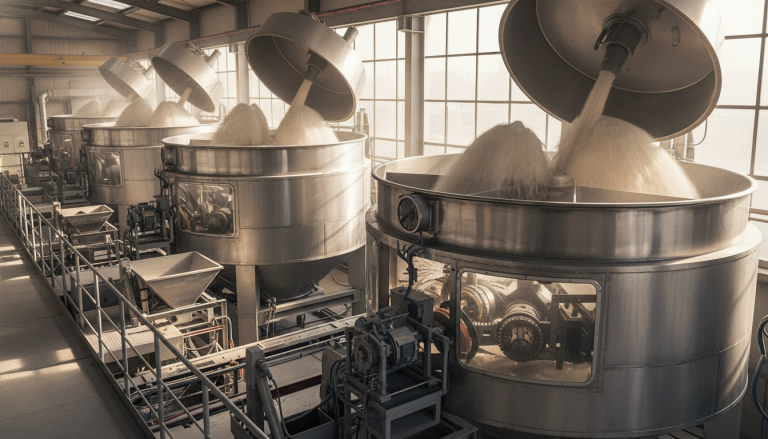
I’ll never forget my first time in a pharma plant. That massive batch mixer completely blew my mind. It spun and tumbled endlessly. It transformed ordinary-looking powders into uniform blends. These blends become the pills we take daily.
Picture this scene. A tiny formulation error ruins thousands of tablets. But a reliable mixer keeps that error under 0.01%. A Reddit quality engineer once vented: “Uneven mixing? That’s no joke. FDA will make you recall the entire batch.”
Why Do Pharma Plants Love and Hate Batch Mixers?
Quora’s Professional Take: Precision Is Everything
On Quora’s “What makes a good pharmaceutical batch mixer?” thread, something caught my eye. A process engineer with 15 years shared this insight:
“People think mixing means just ‘stirring stuff.’ In pharmaceuticals, it’s a molecular-level science. API (Active Pharmaceutical Ingredient) distribution must be absolutely uniform. Otherwise, you might get a ‘placebo’ or a ‘double dose.’”
His key points included:
- Mixing time: Too short causes unevenness. Too long damages particle structure.
- Speed control: Different materials need different shear forces.
- Dead zones: Container corners trap contamination easily.
Another top answer emphasized traceability. Every batch’s mixing parameters must be recorded. That’s why modern Pharmaceutical Mixing Machines come with PLC systems and data logging.
Reddit’s Real Talk: When Dreams Meet Reality
Jump to Reddit’s r/pharmaceuticalmanufacturing board. The vibe totally shifts.
One operator complained: “Our old V-blender takes 3 hours to clean! Our new one has CIP (Clean-in-Place). It takes 20 minutes.” The comments section filled with “+1” replies. Cleaning efficiency is clearly a universal pain point.
Someone shared a “disaster scene”:
“We switched excipient suppliers once. After mixing, we found a huge clump stuck to the blades. Turned out it was static electricity. We had to switch to anti-static coated equipment.”
Think about it. This “accident” seems harmless in labs. But in commercial production, every minute costs real money.
Choosing Batch Mixers: Which Traps Must You Avoid?
Trap 1: Blindly Chasing “All-in-One” Solutions
I initially thought equipment should have every feature possible. But I learned something. An “all-purpose” mixer often means no feature excels.
A Quora sales manager from a Solid Dosage Equipment Manufacturer spoke bluntly:
“Clients always want machines that mix powders, granules, and do wet granulation. But you know what? Different processes need totally different mixer requirements. Forcing compatibility means doing everything poorly.”
Practical advice:
- Clarify your main application (powder-powder mixing? Powder-liquid?)
- Prioritize specialized equipment over “complete packages”
Trap 2: Overlooking Material Compatibility
A Reddit post documented a “crash and burn” experience. A company bought a 316L stainless steel mixer. They discovered their formulation contained chlorides. The equipment corroded.
This reminds us:
- Strong acids/bases → Need Hastelloy or titanium alloy
- High humidity → Must consider rust prevention
- Oil-based ingredients → Interior walls need special polishing
Trap 3: Underestimating Validation Costs
Another Quora discussion broke down the numbers:
- Equipment itself: $50,000
- IQ/OQ/PQ validation: $15,000
- Training and SOP writing: $5,000
- Annual maintenance: $8,000
Total cost far exceeds equipment price. Those cheap “plug-and-play” machines? They’ll make you cry during validation.
Different Batch Mixer Types: Which One Should You Pick?
V-Blenders: Old Reliable, But Somewhat Picky
Pros:
- Simple structure, low failure rate
- Great for free-flowing powders
- Easy to clean
Cons:
- Can’t handle sticky or wet materials
- Relatively long mixing time (15-30 minutes)
A Reddit user’s review hit the mark: “If your formula’s simple and batches small, V-blenders are king. But don’t expect them to handle ‘difficult’ materials.”
Double-Cone Mixers: The Gentle Choice
Compared to V-type, double-cone rotation is gentler. Perfect for fragile granules. But a Quora answer pointed out its limitation:
“Double-cone mixers have worse dead zone problems. Especially at cone tips. If your API is under 1%, local concentration deviations might occur.”
3D Mixers: Rising Star, But Pricey
This equipment moves along three axes simultaneously. Mixing results are genuinely more uniform. A technical director from a Solid Dosage Equipment Manufacturer shared on Quora:
“We’ve tested 3D mixers. They keep RSD (Relative Standard Deviation) under 3%. V-type might hit 5-8%.”
But someone in comments threw cold water: “Price is 2-3 times V-type. Complex structure means high repair costs. Unless you’re making premium formulations, it’s unnecessary.”
High-Shear Mixers: Beautiful Violence
When you need to disperse liquids into powders quickly. Or break up agglomerates fast. This is your tool.
A Reddit granulation process discussion mentioned:
“Our high-shear mixer completes wet granulation in 5 minutes. Traditional methods take 20. But the cost is high energy use, loud noise. It demands more skilled operators.”
Industry Trends: Smart Technology Changes Everything
From “Experience-Based” to “Data-Driven”
Previously, mixing completion relied on masters “looking” and “feeling.” Now, PAT (Process Analytical Technology) makes everything visible.
A Quora automation engineer shared excitedly:
“We installed NIR spectroscopy in our mixer. It monitors material uniformity in real-time. The system automatically determines when to stop mixing. Saves time and prevents over-mixing.”
This reminded me of a Reddit comparison:
- Traditional method: Fixed 20-minute mixing → Same time per batch, quality fluctuates
- Smart method: Dynamic adjustment based on real-time data → Some batches done in 12 minutes, others need 25, but quality stays stable
Not every batch finishes equally fast. Every batch achieves equal quality – that’s what matters.
Modular Design: Multi-Use Done Right
Some Pharmaceutical Mixing Machine suppliers now offer “interchangeable container” solutions:
- Small batch (10L) for R&D
- Medium batch (100L) for pilot trials
- Large batch (500L) for commercial production
Same main unit, different containers. Both flexible and economical.
Final Thoughts: Choose Your Mixer Well, Workshop Troubles Fall
Back to the opening question. Is a batch mixer really just a “stirrer”?
Obviously not. It’s the production line’s “master blender.” It determines your final product’s quality baseline. Choose right, your quality reports stay green. Choose wrong, rework, complaints, recalls… one after another.
If you’re struggling with equipment selection, ask yourself three questions:
- What are my material properties? (Particle size, flowability, moisture)
- What’s my production volume? (Lab scale? Pilot? Commercial?)
- What’s my validation capability? (Professional team? Need full supplier support?)
There’s no “best” in equipment selection. Only “most suitable.” Those industry peers sharing on Quora and Reddit. The pits they fell into. We should avoid them when possible.
After all, a reliable Batch Mixer isn’t just production equipment. It’s your “quality gatekeeper.”