
Wet Granulation Process: The Truth Behind Pharma’s “Magic Kitchen”
When Pill Making Meets “Dough Kneading” Philosophy
First time I heard about wet granulation, I thought: isn’t this just industrial dough-making?
But think about it. This seemingly simple process is one of pharma’s core technologies. I spent time on Quora and Reddit’s pharma boards. The discussion heat surprised me. Engineers with decades of experience share their mistakes. Quality control folks complain about equipment choices. Interns ask why their granules turn out too hard or soft.
One post on r/PharmaceuticalManufacturing got 200+ upvotes. Title: “Wet granulation isn’t science, it’s art—dark art.”
Exactly right.
Why Drug Factories Can’t Live Without This “Dough” Process
The Powder’s Awkward Problem
A pharma engineer on Quora nailed it:
“Imagine compressing flour-fine drug powder into tablets. Direct compression? Either it won’t compact or it crumbles. Powder particles too small means poor flow. Dosage control becomes impossible.”
That’s why wet granulation exists—turning loose sand into controllable building material.
A quality manager at an Indian generics plant added real pain points:
- ❌ Direct powder compression: tablet weight varies ±15% (pharmacopeia usually requires ±5%)
- ❌ Segregation issues: active ingredients and excipients separate during transport due to density differences
- ❌ Dust explosion risk: fine powder reaches certain airborne concentration, one static spark triggers disaster
After wet granulation, flowability improves 3-5 times. Tablet weight deviation stays within ±2%.
Wet Granulation’s “Three Moves”: Simple Looking, Devil in Details
First Move: Mixing
This step isn’t controversial. Throw drug substance and excipients (starch, lactose, etc.) into mixer. Run 10-15 minutes. Ensure uniform distribution.
But one high-voted Quora answer mentioned an overlooked point: mixing time isn’t longer-is-better.
“We once extended mixing from 15 to 30 minutes for ‘safety.’ Tablet disintegration time actually increased. Later learned excessive mixing distributes certain excipients (like magnesium stearate) prematurely to granule surfaces. Forms hydrophobic layer. Affects drug release.”
Reminds me: in pharma processes, every parameter exists for a reason. Don’t get clever.
Second Move: Granulation
This is the soul step. Simply put: add “binder” to powder (usually water, ethanol, or starch paste). Mix while adding. Let powder form small granules.
Reddit has a post discussing “why are my granules either too wet or too dry?” Over 50 replies below. Almost everyone has horror stories:
Too wet consequences:
- Granules stick together like wet dough, can’t pass screen
- Drying time doubles, energy costs skyrocket
- Microbial growth risk (someone shared entire batch scrapped after weekend delay)
Too dry consequences:
- Granules too loose, turn back to powder during compression
- Tablet hardness fails specs, crumbles during transport
A 20-year veteran engineer summarized a rough method: “Grab some granules. Should clump but scatter with light touch. That moisture is perfect.”
This “feel method” got replaced by PAT (Process Analytical Technology) sensors in modern plants. But core logic unchanged—moisture control is granulation’s key.
Third Move: Drying & Sizing
After granulation, moisture content is 15-25%. Must quickly throw into fluid bed dryer or oven. Reduce moisture to 2-5%.
A quality director on Quora gave interesting insight:
“Drying temperature isn’t higher-is-better. We once raised temperature from 50°C to 70°C to rush schedule. Found certain heat-sensitive drugs (like vitamin C) dropped 8% content. FDA audit directly flagged us for correction.”
After drying comes “sizing”—breaking big granules, screening small ones. Final result: uniform particle size granules (typically 80% between 0.5-1.5mm).
Reddit complaint: “The mill is like a temperamental chef. Too fast, granules become powder. Too slow, output makes you cry.”
Right Equipment Equals Half the Success
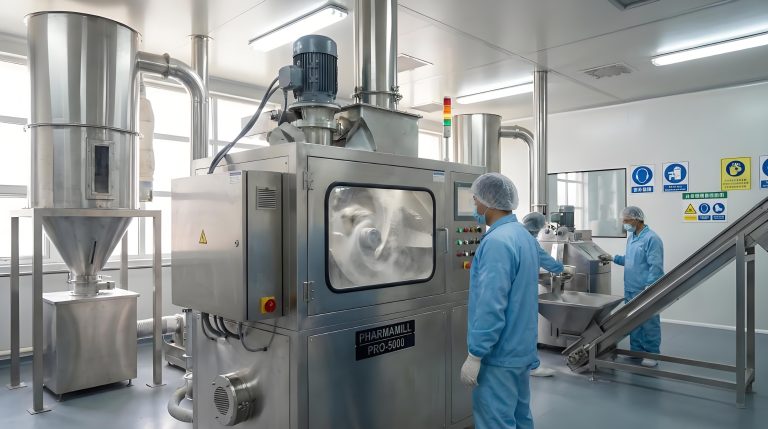
Must mention Solid Dosage Equipment Manufacturer role here.
On r/PharmaTech, one post compared different high-shear mixer granulator brands:
- European brands (like GEA, Alexanderwerk): high precision, strong automation, but prices keep small factory owners awake (equipment starts at millions RMB)
- Chinese brands: cost-effective, but early products’ control system stability criticized as “roller coaster”
- Used equipment market: someone shared finding 90% new equipment from bankrupt plant, saved 60% budget, but “risk at your own”
A CMO (Contract Manufacturing Organization) project manager was practical:
“Choosing Solid Dosage Equipment Manufacturer isn’t about who’s cheapest. Three points: 1) After-sales response speed (one day downtime costs millions). 2) Complete validation documents (FDA/EMA audit ready). 3) Spare parts supply (some small factories can’t find parts after three years).”
Equipment selection: cutting corners means coming back crying for upgrades later.
Wet Granulation’s “Dark Side”: Traps Nobody Tells You
Trap One: Water Quality’s Invisible Killer
Scary Quora case:
A plant used tap water as binder. Produced three batches. Found dissolution data abnormal. Investigated two weeks. Discovered—city water switched sources in winter. Hardness rose from 50ppm to 200ppm. Calcium-magnesium ions complexed with certain drugs.
Since then, all pharma wet granulation switched to purified water or water for injection.
Trap Two: Seasonal Nightmare
An engineer building plant in Southeast Asia complained on Reddit:
“Process parameters perfected in Germany totally collapsed in Thailand. Rainy season 80% humidity, granules won’t dry. Dry season 30% humidity, powder static shocks people, granulation changes again.”
They spent six months building four seasonal parameter databases.
Trap Three: Cleaning Validation’s “Bottomless Pit”
Quality manager on Reddit grumbled:
“Disassembling and cleaning wet granulation equipment once takes 2 people 6 hours. Cleaning validation (proving previous batch residue below safety limit) requires sampling and testing. Wait two more days for results. Production efficiency? Doesn’t exist.”
That’s why many plants now try dry granulation (direct roller compaction) or fluid bed all-in-one equipment (mixing-granulation-drying in one sealed vessel).
Future Trends: From “Dark Art” to “Transparent Science”
Recent years, pharma industry pushes QbD (Quality by Design) concept. Core idea: don’t test quality after production. Build quality control into process design stage.
For wet granulation specifically, this means:
- Real-time monitoring: NIR (near-infrared spectroscopy) sensors measure granule moisture real-time, auto-adjust binder amount
- Digital twin: simulate 1000 granulation processes in virtual environment, find optimal parameter combinations
- Continuous manufacturing: abandon traditional “batch production,” adopt car assembly line-style continuous production
Pfizer engineer revealed on Quora:
“Our continuous manufacturing line: from raw material input to tablet output, only 4 hours total (traditional process takes 3-5 days). Batch-to-batch variation nearly zero.”
But he admitted equipment investment alone exceeds $50 million. Small factories can’t afford it.
Final Thoughts: Pharma Process “Warmth”
After reading hundreds of Quora and Reddit discussions, my biggest takeaway:
Wet granulation looks like technical problem. Essentially it’s “people” problem.
Equipment parameters can standardize. But site humidity, operator feel, slight raw material batch differences… these variables make each batch a small gamble.
Those masters with decades on frontlines judge problems from granule color and feel. This experience even advanced AI can’t learn.
Next time you swallow a tiny pill, think about:
It possibly went through 72-hour process flow. Passed 15 quality checkpoints. Result of collaboration among dozens of engineers, inspectors, operators.
That pill worked hard to get here.