
Dry Granulation Process: A Pharma Game-Changer or Overhyped Tech?
When I first heard “dry granulation,” I thought: isn’t this just compressing powder? How complex can it be?
Turns out, I was dead wrong.
On Quora and Reddit, pharma engineers debate dry granulation process endlessly. Some call it a “game-changer for pharma manufacturing.” Others complain: “equipment costs a fortune, wet granulation is more stable.”
This made me curious. What’s really behind this seemingly simple process?
Why Are Pharma Companies Obsessed With Dry Granulation?
Real Talk on Reddit: Cost Anxiety
On r/PharmaceuticalEngineering, an Indian pharma engineer posted:
“My boss is obsessed with installing dry granulation lines. He says ‘saves water and energy.’ But I calculated equipment investment. One roller compactor starts at millions. Can this ROI actually break even?”
The thread exploded. Responses varied:
- “Is water scarce there? If yes, dry granulation saves more than water bills. Wastewater treatment costs matter too.”
- “Don’t just look at equipment prices. Did you calculate drying energy costs for wet granulation? Our factory’s annual dryer electricity bills could buy half a new machine.”
- Some pushed back: “Dry method needs quality raw materials. If your powder has poor flowability, granule density becomes uneven. Tablet compression will suffer badly.”
See the real industrial dilemma? Tech choices aren’t about ‘which is more advanced.’ They’re about ‘which fits my budget and production line.’
Quora Deep Dive: Wet vs Dry Core Differences
A Pfizer process development expert wrote a long post. Core point:
“Dry granulation isn’t about being ‘better.’ It’s about avoiding wet method pitfalls.”
He listed key scenarios:
- Water-unstable APIs: Some antibiotics degrade when wet. Wet granulation becomes impossible.
- Low-dose drugs: Milligram-level drugs risk uneven distribution in wet mixing. Dry roller compression “locks in” uniformity forcibly.
- Fast scale-up: Wet methods require adjusting countless parameters from lab to industrial scale. Dry methods have fewer parameters. Lower trial-and-error costs.
But he admitted: “Dry granulation’s biggest enemy is the raw material itself. If powder compressibility is poor, the ribbon crumbles like cookie crumbs. The screening step becomes a disaster.”
Equipment Investment’s “Hidden Costs”: More Than Just Buying Machines
This part feels most underestimated to me.
Reddit Engineer’s Painful Lessons
A US pharma maintenance supervisor vented:
“We installed a dry granulation line three years ago. Sales promised ‘maintenance-free for ten years.’ Now roller surfaces are severely worn. Replacing one roller pair costs $500,000. Plus two weeks downtime. My boss keeps asking: ‘Didn’t you say this saves money?’”
Responses added:
- “Is your roller compactor sensitive to material hardness? Did you add hard excipients? Silica and calcium carbonate are roller killers.”
- “Do regular roller surface hardening. Expensive but cheaper than replacing entire rollers.”
This highlights an overlooked point: When choosing solid dosage equipment manufacturers, after-sales service matters more than brand fame.
A European engineer shared:
“We use German roller compactors. Initial investment was 30% higher. But they have localized service teams in Asia. Sufficient spare parts inventory. The neighboring factory bought cheap domestic equipment. A critical part broke. Took two months to ship from China. Downtime losses were ten times the price difference.”
Choosing equipment manufacturers means picking ‘long-term partners,’ not ‘one-time transactions.’
Technical “Devils” in Details: Why Some Succeed, Others Fail
Quora Top Answer: Art of Roller Parameters
A 15-year Novartis process expert said:
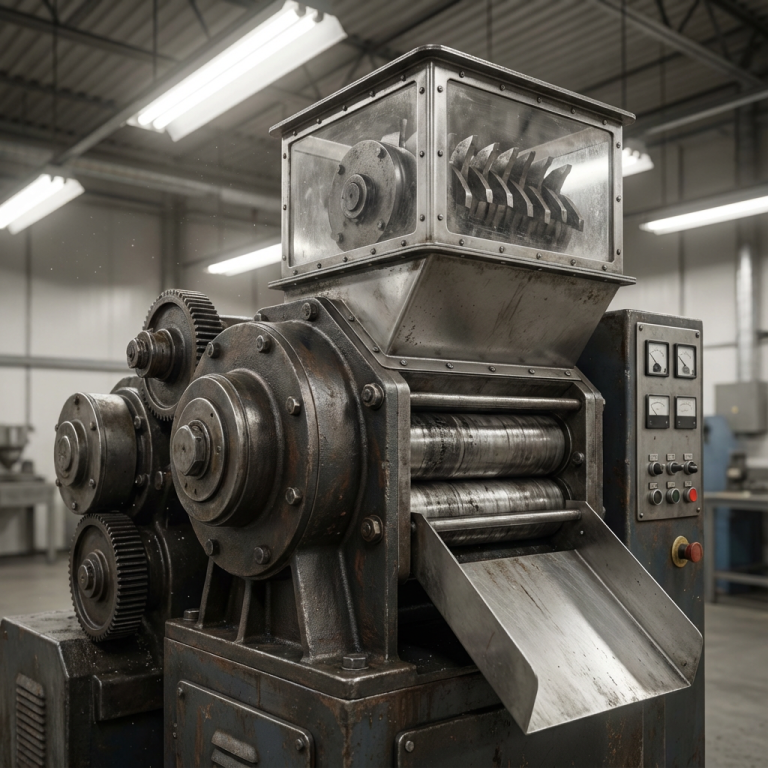
“Dry granulation looks like just three core parameters: roller pressure, roller speed, roller gap. But each parameter triggers chain reactions.”
His example:
- Too little pressure: Ribbon too brittle. After screening, fines exceed standards. Wastes raw materials.
- Too much pressure: Granules too hard. During tableting, disintegration slows. Drug release delays.
- Mismatched speed and gap: Material dwells insufficiently in the roller nip. Compaction fails. Too long? Over-compression occurs.
Simply put, this is a ‘three-body problem.’ Adjust one parameter, the other two must follow.
Reddit Case Study: Failed Dry Granulation Project
An Indian generic drug company’s QA manager shared an incident:
“We tried replicating original drug’s dry process. Tablet hardness fluctuated wildly. Later found raw material batches had huge flowability differences. First batch rolled smoothly. Second batch jammed the feeder directly.”
Solution?
- Added 0.5% fumed silica to improve flowability.
- New problem emerged: silica absorbs moisture. Final tablets became unstable in high humidity.
They eventually abandoned dry method, returned to wet. Sometimes ‘technically feasible’ differs from ‘industrially viable.’
Future Trends: Will Continuous Manufacturing Replace Batch Production?
This sparks the fiercest debates on Quora and Reddit.
Supporters’ Views
A Johnson & Johnson process engineer said:
“Continuous dry granulation is the future. FDA approved several continuously produced drugs. Advantages are obvious:
- Real-time quality monitoring: No waiting until batch end for testing. Adjust during process.
- Small footprint: Traditional batch production needs multiple bins. Continuous only needs one pipeline.”
Skeptics’ Counterattack
But a Reddit senior formulation scientist poured cold water:
“Continuous sounds beautiful. Did you calculate ‘changeover validation’ costs? Traditional batch production switches products. Clean equipment in half a day. Continuous production line switches products. Entire pipeline needs disassembly and cleaning. If residues exceed limits, entire batch scraps.”
Someone added:
“Small-variety drugs don’t suit continuous production. Our factory produces one product twice yearly. Just a few hundred kilograms each time. Install continuous equipment? My boss would kill me.”
My Personal Reflection: Tech Worship vs Pragmatism
After reading these discussions, my feeling:
Dry granulation process itself isn’t right or wrong. Wrong is the ‘one-size-fits-all’ thinking.
- If your product has:
- Water-sensitive API
- Large volume, amortizing equipment costs
- Good raw material compressibility
- But if you have:
- Poor raw material flowability, reluctant to add lubricants
- Tight equipment budget, no reliable solid dosage equipment manufacturer providing technical support
- Short product lifecycle, obsolete before ROI
Pharma manufacturing isn’t about who uses cooler technology. It’s about who finds optimal balance between cost, quality, and compliance.
Final Question: Would You Pay for “Water Savings”?
One Reddit user’s comment impressed me:
“Our factory is in Africa. Local water costs are ten times China’s. Government restricts industrial water usage. For us, dry granulation isn’t ‘advanced technology.’ It’s a ‘survival necessity.’”
This reminds me: Technology value always depends on how much your problem hurts.
If your location has abundant water, cheap labor, multiple equipment suppliers, wet granulation might remain optimal. But if you face environmental pressure, rising energy costs, or stricter drug approval requirements, dry granulation—and solid dosage equipment manufacturers offering full lifecycle services—might be your lifeline.
Technology never exists in isolation. It embeds within entire business logic.