
The “Secret Weapon” in Pharma Granulation: Why More Factories Choose Slugging Granulators?
Why Did Dry Granulation Suddenly Take Off?
Professional Insights from Quora
On Quora, there’s a question with over 100,000 views: “Why is dry granulation gaining popularity in pharmaceutical manufacturing?”
A formulation scientist with 15 years’ experience gave a blunt answer:
“Not all APIs can ‘swim.’ Some break down in water. Others hate heat. Then you tell me to use wet granulation? That’s burning money.”
He shared an example. A diabetes drug lost 12% potency with wet granulation. With Slugging Granulator, loss stayed under 2%.
Here’s something interesting: Comments noted dry granulation needs precise powder properties. Not every Pharmaceutical Granulation Machine handles this well. Fair point. We’ll dig deeper later.
Real Talk and Experience on Reddit
Jump to Reddit’s r/Pharma. The vibe gets real.
One post says: “Dry granulation saved our production line (but almost killed our QC team).”
The poster, a production manager, reported results after adding Slugging Granulator:
- ✅ Cycle time dropped from 8 hours to 3
- ✅ Energy use down 40% (no drying needed)
- ✅ Equipment footprint cut in half
But what’s the catch?
“First three months were hell. Tablet hardness bounced around. Powder separated. Rework hit 30%. Turns out the roller compactor pressure was wrong.”
The post got 67 replies. Everyone shared “avoid these mistakes” tips:
- Keep raw material particle size within ±10%
- Find reliable Solid Dosage Equipment Manufacturers. Cheap ones cause disasters
- One person bought used equipment. Worn rollers made granules like sand
How Does Slugging Granulator Actually Work?
The Principle is Simple
Here’s a rough comparison: Wet granulation is like kneading dough. Dry granulation is like pressing crackers.
The process:
- Powder goes in directly (no water or binder)
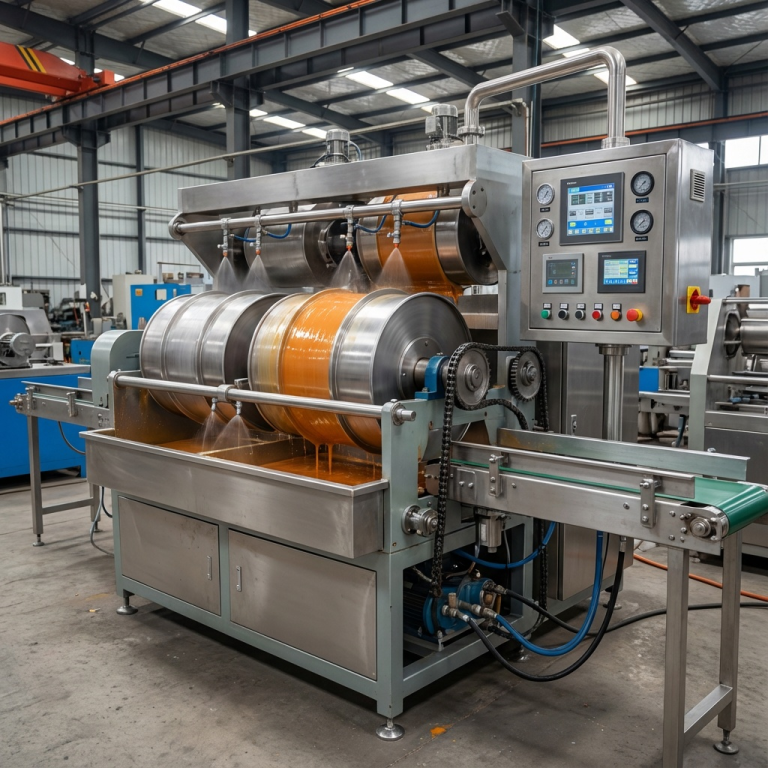
- High-pressure rollers compress it into “slugs” (called slugging or compaction)
- Slugs get crushed and sieved into granules
- These go straight to tableting or capsule filling
Sounds easy? The devil’s in the details.
Warnings from Quora Veterans
An engineer from a large Indian generic drug factory shared a case:
They compared three Solid Dosage Equipment Manufacturer proposals for Pharmaceutical Granulation Machine:
- Factory A: Cheapest price. But roller compactor only handled free-flowing materials
- Factory B: Mid-range. Had pre-compaction system. Good adaptability
- Factory C: Crazy expensive. Claimed “fully automated intelligent adjustment”
They picked B. Why?
“A’s equipment killed us during setup. Any sticky powder jammed it. C’s machine was great. But maintenance cost three times B’s. Plus parts shipped from Germany. One month wait.”
This reminds me of a key issue: Many companies only ask “does it work?” They ignore “what if it breaks?” In pharma, one day’s downtime costs millions.
When Should You Choose Slugging Granulator?
Reddit Users’ “Three Key Scenarios”
On r/Pharma, there’s a pinned post: “When dry granulation makes sense (and when it doesn’t).” The poster is a validation engineer. He made a chart:
✅ Good for dry granulation:
- API unstable with water or heat
- Large dose products (like tablets over 500mg)
- Raw materials flow reasonably well
- Want to save time and energy costs
❌ Not suitable when:
- Powder extremely uneven (wide particle size range)
- Need super-fast dissolution
- API content extremely low (microgram level). Mixing uniformity demands are insane
- Tight budget. Can’t afford good equipment
Comments added: “Also when your quality team lacks capability. Dry granulation demands more process control than wet. CQAs slip slightly? Whole batch scrapped.”
Scary thought. This explains why small pharma companies stick with wet methods. It’s not about avoiding new tech. They can’t handle the risk.
What Traps to Avoid When Buying Equipment?
“Pitfall Guide” from Quora
Someone asked: “What should I look for when buying a slugging granulator?”
A purchaser wrote a long answer. Key points:
- Roller material: Hard alloy is basic. Surface roughness should be adjustable (different materials need different friction)
- Pressure range: Must cover at least 5-50 kN/cm. Too narrow means poor adaptability
- Online monitoring: Good Pharmaceutical Granulation Machines have real-time sensors for roller gap and pressure
- Modular design: Quick screen and blade changes matter. Don’t underestimate this. Time difference can be 10x
But there’s debate here: Comments said over-reliance on automation hurts operators’ “feel” for equipment. Others argued: “It’s 2025. Still talking about feel? Let data speak.”
I lean toward the latter. But I’ve seen experienced workers diagnose problems just by sound. Maybe combining both is best?
“Painful Lessons” on Reddit
On r/Manufacturing, a post titled: “$2M mistake: bought the wrong granulator.”
The poster’s startup pharma company rushed. They bought a “super cost-effective” used Slugging Granulator from a Solid Dosage Equipment Manufacturer.
Results:
- Worn rollers made inconsistent granule hardness
- No GMP certification docs. Regulators demanded fixes during audit
- No spare parts. Equipment became scrap
Most painful line: “We spent three times more on new equipment. Lost half a year. Cheap isn’t saving money. It’s finding trouble.”
Future Trend: Continuous Manufacturing
Industry Outlook on Quora
On “What’s the future of pharmaceutical granulation?” several industry leaders mentioned Continuous Manufacturing.
Traditional Slugging Granulators use batch processing. But more Solid Dosage Equipment Manufacturers develop continuous solutions. Raw materials enter one end. Finished granules exit the other. No stops in between.
Clear advantages:
- More stable quality (less parameter variation)
- Higher equipment utilization
- Aligns with FDA’s QbD concept
But skeptics exist: “Continuous sounds great. Implementation is hard. Process validation, cleaning validation, product changeovers. Each is a pit.”
“Pioneer Practitioners” on Reddit
On r/Pharma, a European pharma company shared continuous manufacturing transformation:
“Took 18 months to validate. PAT system alone cost 5 million euros. But payback period is 3 years. Shorter than expected.”
Comments exploded. Some envied. Others questioned data accuracy. Someone asked: “Which Pharmaceutical Granulation Machine did you use? We want to try.”
Poster replied: “Can’t reveal supplier. But evaluate your technical team first. Continuous isn’t just buying equipment. Needs deep collaboration among process, automation, and quality teams.”
Final Thoughts: No Perfect Tech, Only Right Choices
After all this, is Slugging Granulator worth it?
My view: Not “whether to adopt.” But “is it suitable?”
- If your product hates moisture and heat, dry granulation saves lives
- If you chase efficiency and low energy, it’s wise
- But if your team lacks experience or budget for good equipment, forcing it causes disaster
Final question: As AI and IoT mature, will future Pharmaceutical Granulation Machines “learn” optimal parameters themselves, eliminating human error?
Maybe in ten years, we’ll look back. “Manual parameter adjustment” will feel retro.