
The Hidden Battlefield of Pharmaceutical Ovens: Why Sterilization Ovens Are the Last Line of Defense for Drug Safety
Last year, a pharma plant shut down for three months. An oral drug batch had microbial contamination. The investigation shocked everyone. The problem? A seemingly “normal” sterilization oven.
In drug production, people focus on raw materials and formulas. They watch tablet presses closely. But few realize one truth: An oven can decide the fate of millions of drug doses.
What Do Sterilization Ovens Actually Do? Real Stories from Pharma Engineers on Reddit
I spent two days on r/pharmacy and r/manufacturing. I found something interesting there.
People don’t ask “how to use it.” They ask “why does our oven always fail?”
An engineer at an Indian generic drug plant shared this:
“We spent $500,000 on a sterilization oven. FDA rejected it on first audit. The equipment was fine. We just didn’t understand dry heat sterilization versus regular drying.”
Think about that statement.
A sterilization oven isn’t a big toaster. It doesn’t just “dry” materials. It kills all microbes through sustained high heat. Usually 160-180°C for 2-4 hours. This includes spores that survive boiling water.
But there’s a contradiction here. Too hot destroys active ingredients. Not hot enough leaves microbes alive. A pharma engineer on Quora said:
“Setting sterilization oven parameters? That’s where we fight hardest with microbiologists.”
The Dilemma of Solid Dosage Equipment Manufacturers
Let’s talk about an underrated player: solid dosage equipment manufacturers.
They make tablet presses and coating machines. They also provide sterilization solutions. But problems arise.
Someone on Quora asked: “Why won’t most manufacturers deeply customize sterilization ovens?”
The top answer was blunt:
“Too risky. Oven validation involves biological indicator tests. Temperature distribution checks. Airflow simulations. One mistake ruins entire batches. Manufacturers prefer standard models. They won’t take that risk.”
This reminded me of a Reddit post. A pharma quality manager complained:
“We got quotes from three solid dosage equipment manufacturers. Cheap ones felt unsafe. Expensive ones exceeded budget. We picked one that ‘seemed okay.’ First validation failed. Internal temperature variance exceeded 5°C.”
What does 5°C variance mean?
Say you set 170°C for sterilization. But corners only reach 165°C. Spores there might survive. After drugs ship out, proper conditions help them multiply. High humidity, for example. Then products get recalled.
Hot Air Circulation Ovens: Simple Appearance, Hidden Complexity
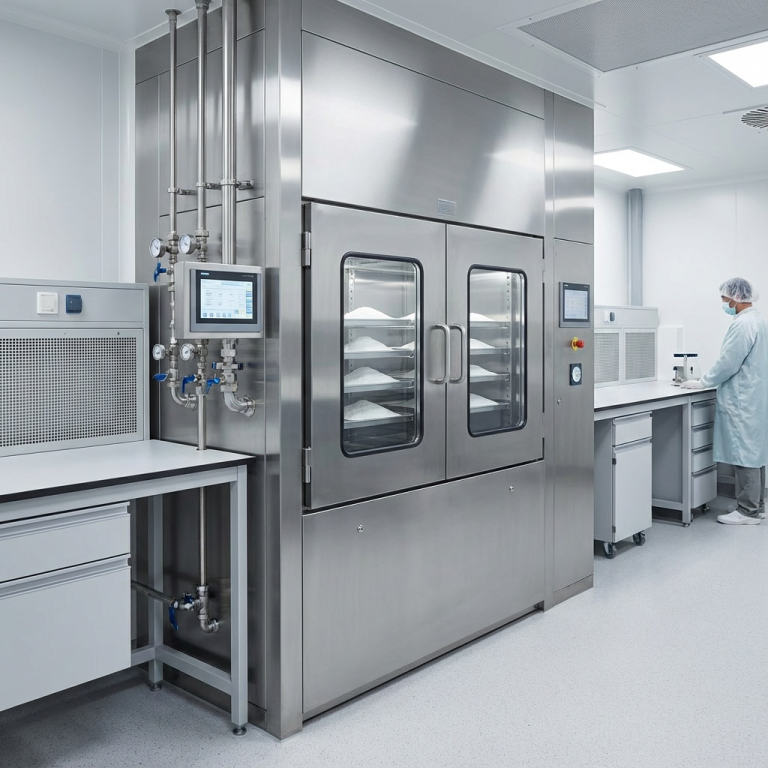
Temperature uniformity brings us to hot air circulation oven design philosophy.
The principle sounds simple enough. Fans force hot air to circulate. This keeps temperature consistent everywhere. But three “devil details” exist in practice:
1. Airflow Design: Direct or Side Blast?
Reddit has a dedicated thread on this. A German equipment engineer said:
“We tested 12 airflow layouts. ‘Top supply + bottom return’ had smallest temperature variance. But costs 40% more than regular designs.”
Why? Airflow must bypass all material trays. It can’t create dead zones. This requires precise CFD simulation. You can’t just weld steel plates together.
2. Heating Method: Electric or Steam?
This sparks huge debates on Quora.
- Electric heating: Precise temperature control. But high energy costs. Expensive maintenance.
- Steam heating: Energy efficient and eco-friendly. But needs boiler support. Must prevent condensation dripping on products.
An engineer in Bangladesh shared a painful lesson:
“We used steam-heated hot air circulation ovens. Poor pipe insulation caused steam condensation. It dripped onto sterile powder. Entire batch scrapped. Lost $200,000.”
3. HEPA Filters: Save Money Here, Regret Later
Many think hot air circulation ovens just need right temperature. They ignore a fatal issue: Is the circulating air itself clean?
A Reddit post explained this vividly:
“Imagine your oven sterilizing at 170°C. But intake air carries workshop dust. Skin flakes. Microbes. Like doing sterile surgery with windows open.”
High-end sterilization ovens include HEPA filters. But these cost money! An H14-grade filter costs over 10,000 yuan. Requires regular replacement too.
Some manufacturers cut corners. They use cheap pre-filters instead. FDA audits immediately flag this as “non-GMP compliant.”
Industry Secret Nobody Mentions: Why Are “Old Devices” More Reliable?
I saw a counterintuitive point on Quora.
An Italian pharma veteran with 30 years said:
“We have a 1985 German sterilization oven. Still using it today. Not because we’re poor. Because it’s too stable. Temperature fluctuation under ±2°C. Never had microbial contamination.”
His explanation enlightened me:
- Old equipment uses mechanical temperature control. Not smart, but low failure rate. Stable response.
- New equipment adds sensors for “intelligence.” Touch screens. PLC controllers. Any module failure paralyzes the whole system.
Another Reddit discussion came to mind:
“We bought an oven with IoT monitoring. Software bug caused incorrect temperature logging. Entire batch validation reports became invalid.”
It’s not that smart tech is bad. But in zero-tolerance pharma, stability beats fancy features.
Evolution of Solid Dosage Equipment Manufacturers: From “Selling Equipment” to “Selling Systems”
Top solid dosage equipment manufacturers changed approaches recently.
Before, they’d sell you an oven. Install and debug, then leave. Now they:
- Provide full validation services: Including IQ/OQ/PQ confirmation
- Train your team: Daily maintenance. Identifying failure signs early.
- Remote monitoring: Real-time parameter tracking via cloud. Early warnings.
A pharma procurement manager on Reddit said:
“We don’t check price anymore. We check Total Cost of Ownership. An oven $100,000 cheaper but causing 3 annual shutdowns? Actually more expensive.”
But new problems emerge: data security.
A Quora thread discussed: “What if hackers tamper with sterilization oven data?”
Sounds like sci-fi. But pharma plants faced similar attacks in 2021. Many manufacturers now use “physical isolation.” Critical equipment stays offline. Data transfers via encrypted USB drives.
Back to the Original Question: What Does a Good Sterilization Oven Look Like?
Based on hundreds of Quora and Reddit discussions, here’s my “no-pitfall checklist”:
Technical aspects:
- Temperature uniformity: ≤±3°C (FDA requirement)
- Heating speed: Room temp to 170°C within 60 minutes
- Door sealing: Leakage rate <0.5% (prevents external contamination)
- HEPA filtration: At least H13 grade
Service aspects:
- Can manufacturers provide complete validation documents?
- Do they have local after-sales teams? (Remote guidance can’t solve everything)
- How long for spare parts delivery? (Key parts shortage stops production lines)
Hidden costs:
- Energy consumption: A 300L oven costs over 50,000 yuan annually
- Validation fees: Initial + annual revalidation. Budget at least 100,000 yuan.
- Downtime losses: Each shutdown day costs multiples of equipment price
Let’s Talk About Something “Politically Incorrect”
Work in pharma equipment long enough, you see brutal reality:
Many pharma plants buy sterilization ovens not to “use well” but to “pass audits.”
An anonymous Reddit user (claiming FDA auditor status) said:
“I’ve seen too many plants. Beautiful parameter sheets. Actual production ignores those standards. Why? Strict compliance drops output 30%.”
This is the industry gray zone. Walking tightrope between ‘compliance’ and ‘profit.’
But think differently. These contradictions and games drive stricter standards. They advance technology.
Some solid dosage equipment manufacturers now develop pulse sterilization technology. Brief ultra-high temperature (250°C, 30 seconds) plus rapid cooling. Kills germs without damaging efficacy. Reddit already discusses these “next-generation sterilization ovens.”