
Perforated Pan Coaters: Truths Technical Manuals Won’t Tell You
Opening
“Problems again!” Yesterday afternoon, my friend Old Wang’s WeChat jolted me from my nap. He manages production at a mid-sized pharma company. His newly purchased perforated pan coater has been driving him crazy. “We followed the manufacturer’s parameters exactly. Why are the tablets still bumpy?”
Many pharma people face this confusion. Behind tablet coating’s seemingly simple process lurk many pitfalls. Let’s talk about perforated pan coaters today. Equipment we love and hate.
Why Choose Perforated Pan Coaters? Looks Great
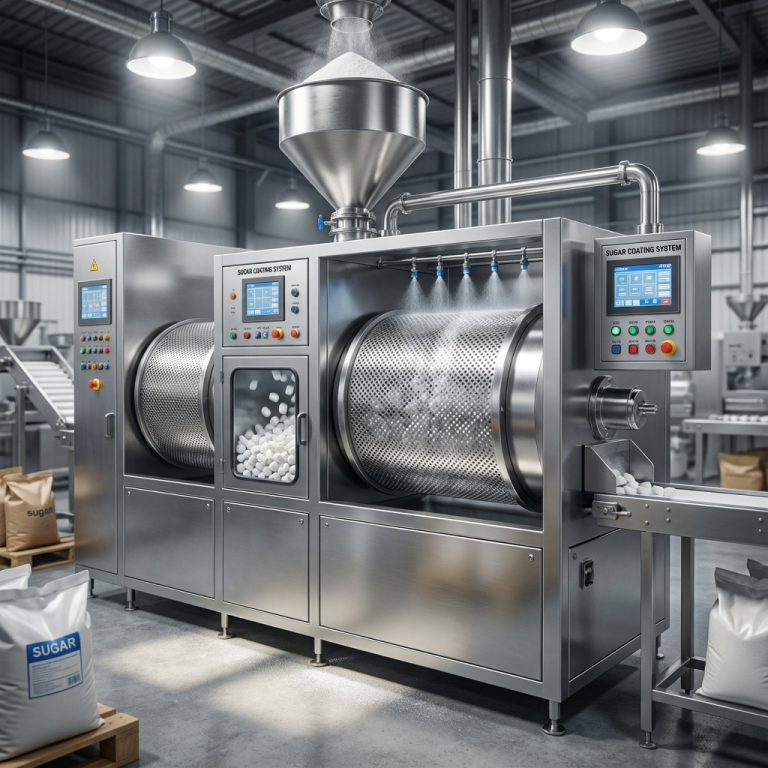
Perforated pan coaters work appealingly. Hot air penetrates the tablet bed through pan perforations. This enables more uniform drying. Compared to traditional coating pans, they offer clear advantages theoretically.
Higher drying efficiency. Traditional pans rely on surface hot air only. Perforated pans let airflow pass directly through tablet beds. This greatly shortens drying time. Some manufacturers claim 30-40% efficiency improvements.
Better coating uniformity. Airflow penetration gives each tablet relatively uniform heat distribution. This reduces thickness inconsistencies from position differences.
Suitable for aqueous coating materials. With rising environmental requirements, aqueous coating is trending. Perforated pans have natural advantages here.
Sounds perfect, right? But reality is always more complicated than ideals.
Real “Pitfall” Experiences
Parameter Adjustment Is Technical Work
The most common complaint on technical forums is “difficult parameter adjustment.”
A process engineer with ten-plus years told me: “Traditional coating pans are slow but linear. Higher temperature means faster drying. Slower spray means thinner coating. But perforated pans aren’t linear. They’re multi-variable coupled systems.”
His words rang true. Perforated pan coaters require controlling simultaneously:
- Pan speed (usually 2-12rpm)
- Spray rate
- Inlet air temperature and flow
- Bed pressure drop
- Atomization air pressure
These five parameters interact. Changing any one triggers chain reactions. I’ve seen factories spend three months optimizing new product parameters. They wasted many tablets in the process.
“Orange Peel Effect” Causes Headaches
Search coating problems online. “Orange peel effect” definitely ranks top. Tablet surfaces become rough and uneven. They look like orange peels.
Causes are complex: excessive coating viscosity, insufficient atomization, overly fast drying. On perforated pans, changing airflow patterns make this problem more unpredictable.
A generic drug friend told me: “Same formula worked fine on traditional pans. Switched to perforated pans, got orange peel. We discovered penetrating airflow made solvent evaporate too quickly. Coating material couldn’t level out.”
New Cleaning Validation Challenges
Many people overlook this issue. Perforated pan hole designs improve drying efficiency. But they bring cleaning troubles.
Residue easily gets stuck in holes. Especially after using colored coating materials. Traditional CIP (Clean-in-Place) systems might not suffice. They need additional ultrasonic cleaning or special cleaning procedures.
A European pharma quality manager shared their experience: “We made stricter cleaning validation standards specifically for perforated pans. This includes residue testing for each hole. The process definitely increased costs.”
Coating Machine Selection: No Standard Answer
Communicating with solid dosage equipment manufacturers revealed something interesting. Almost no manufacturer says their equipment “doesn’t suit” your product.
Fluid Bed vs Perforated Pan: Each Has Merits
Many people compare perforated pan coaters and fluid bed coaters. From what I understand:
Fluid beds suit small, lightweight tablets better. Tablets need suspending in airflow. But for large or heavy tablets, fluid beds struggle.
Perforated pans have broader application ranges. They handle almost all tablet sizes. But the trade-off is more complex equipment. Operation difficulty is also higher.
A multinational pharma friend said: “Our company has three coating equipment types. We choose based on specific products. No single machine solves all problems.”
Large-Scale Production Considerations
Small-scale, pilot success doesn’t guarantee production success. Perforated pan coaters often have unexpected scale-up problems.
Airflow distribution, heat transfer, tablet movement trajectories. Parameters appearing normal in small equipment may completely change at industrial scale.
I know a company. Their 20kg lab equipment ran perfectly. But scaling to 200kg production equipment caused coating uniformity issues. They discovered large equipment airflow distribution was less uniform than small equipment.
Some “Imperfect” Practical Suggestions
Through years of observation and communication, I’ve summarized practical tips:
New equipment needs a break-in period. Don’t expect immediate ideal performance after purchase. Reserve enough time and materials for parameter optimization.
Build your own database. Manufacturer parameters are just references. Every factory environment differs. Record each adjustment’s data. Gradually accumulate experience.
Emphasize operator training. Perforated pan coaters demand higher operator skills. Experienced operators can hear abnormal equipment operation. This beats any monitoring system.
Don’t worship automation. Although current equipment is smart, critical moments still need human judgment. Especially during abnormalities, experience often beats programming.
Final Thoughts
Perforated pan coaters are indeed good technology. But they’re not omnipotent. When selecting equipment, besides technical parameters, consider your team’s capabilities, production scale, product characteristics.
More importantly, all equipment needs time for adjustment and optimization. Don’t get dazzled by manufacturer promotional videos. Don’t completely deny them due to initial setbacks either.
Like Old Wang later told me: “Finally fixed that orange peel problem. Tablets come out prettier than before. But these three months were really exhausting.”