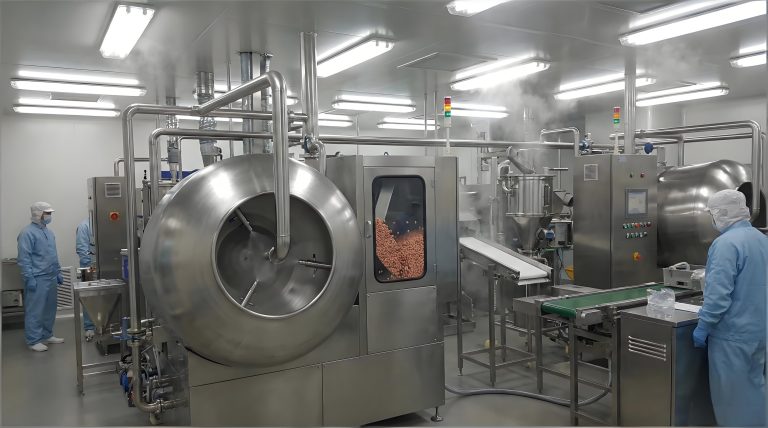

Film Coating vs Sugar Coating: Complete Guide to Drum Coating Machine Process Selection
You know what? Every time we swallow a pill, that smooth surface hides an entire set of precision engineering. Recently stumbled upon tons of discussions about Drum Coating Machines online. Turns out this seemingly niche equipment actually matters to everyone’s medication experience.
From pharmaceutical engineers’ professional analyses on Quora to candy makers’ real-world struggles on Reddit, I’ve gathered some pretty interesting findings. Let’s dive into what these “unsung heroes” are really dealing with.
When Expertise Meets Reality: Two Platforms, Different Views
On Quora, pharmaceutical equipment experts discuss coating machine technical details. Temperature control, spray pressure, rotation speed settings. They’ll tell you how automated coating equipment achieves optimal spray effects. It installs temperature sensors inside drums to prevent overheating risks through precise parameter control.
But switch to Reddit, and it’s a whole different story.
In the CandyMakers forum, a user named Lisa_710’s confusion about finding small “tumbler” equipment stuck with me. She wanted to coat gummies and nuts with sugar. But couldn’t find suitable equipment. Some suggested rock tumblers. Others recommended KitchenAid coating attachments—over 500 bucks, “ridiculously expensive, but actually works great.”
This contrast is pretty interesting. Professional circles discuss industrial equipment’s technical specs. But real users care about: Can I afford it? Does it work well? Will it break?
Coating’s “Two Faces”: Film vs Sugar
What intrigued me most was the debate about film coating versus sugar coating.
Film coating is like dressing pills in a tight “protective suit.” Thin, uniform, doesn’t change pill size. Nearly all newly marketed coated tablets choose this process now. Low cost, high efficiency, plus you can print on it.
Sugar coating is more like wrapping pills in “frosting.” Thick, sweet, shiny. The process is complex and costs more. But that traditional sweetness really makes kids more willing to take medicine.
I initially thought film coating was superior. But later discovered sugar coating actually protects better against moisture and light. It’s just that in our efficiency-chasing era, who has patience for such complex processes?
This reminds me of those colorful sugar-coated tablets from childhood. Sweet, didn’t feel like medicine at all. Today’s film coatings are advanced. But something feels missing somehow.
Equipment’s “Temper”: When Machines Won’t Cooperate
Deeper research revealed coating machines really do have “attitude.”
A Quora answer detailed various causes of coating defects. Wrong crystal form in raw materials causes brittle cores. Poor granulation control means uneven particle sizes. Insufficient compression pressure, inadequate hardness. Wrong coating process parameters. Any step going wrong could cause “edge dropping,” “cracking,” “sticking.”
A Reddit engineer mentioned encountering a “24-chamber solar manufacturing PECVD coating machine.” 130 feet long, 30 independent SERCOS conveyor motors, 72 RF power sources. Sounds headache-inducing just hearing about it.
Most interesting was the discussion about converting washing machine drums into fire pits. Someone worried about drum surface coating. The reply said: “If there’s coating, burn it off with high heat first. Don’t do it with people around.” This straightforward engineering thinking actually felt very real to me.
Devil in the Overlooked Details
While organizing this material, I discovered an easily overlooked issue: rotation speed selection.
The principle for choosing coating pan speed is “select the lowest possible speed while ensuring good tablet bed fluidity.” Sounds simple. But actual operation requires considering core size, shape, friability, loading capacity. If cores are brittle, excessive speed intensifies mechanical force on cores. This causes edge dropping and fragments.
But if spray speed is too slow, coating material films slowly. Mechanical force again intensifies wear on cores. This becomes a technical balancing act requiring precision.
This made me realize something. Every pill we casually swallow has countless engineers behind it. They rack their brains over seemingly trivial parameter adjustments.
The Industry’s “Invisible Hierarchy”
Comparing discussions across platforms, I discovered an interesting “hierarchy.”
At the top are Pharmaceutical Equipment Manufacturers. They make million-dollar industrial equipment. They serve major pharmaceutical companies.
In the middle are various professional coating equipment suppliers. They provide solutions for pharmaceutical factories of different scales.
At the bottom are small workshops and individual users seeking “affordable coating solutions.” They either modify existing equipment or hunt for cost-effective alternatives.
But interestingly, real technical innovation and user experience often come from this “hierarchy’s” bottom. Their needs are more direct, feedback more genuine. This pushes the entire industry to think: What’s the real meaning of technological progress?
Conclusion: Warmth Behind the Technology
After writing this article, I have a whole new perspective on coating machines. They’re no longer cold industrial equipment. They’re bridges connecting pharmaceutical engineers’ professional dedication, small business owners’ practical needs, and everyone’s medication safety.
From Drum Coating Machine’s complex parameter control to candy makers’ longing for simple coating tools, technology’s significance perhaps isn’t about being fancy. It’s about truly solving real problems.
Next time you take medicine, think about those equipment and people working silently. They make pills easier to swallow, last longer, work better.
After all, the best technology should be technology we don’t even notice exists.