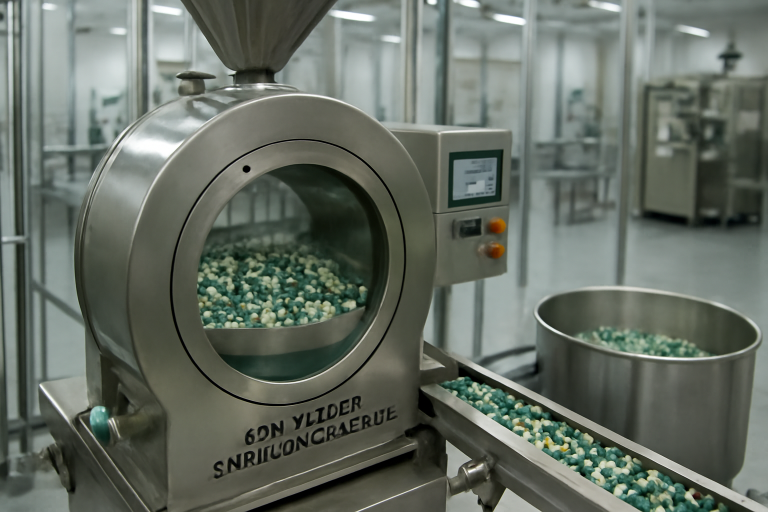

Dry Granulation’s “Hidden Champion”: Why Are Pharma Plants Betting on Roller Compaction?
I. That Unassuming Machine Hides a Multi-Billion Dollar Secret
Last week at a pharma equipment expo, I stared at a roller compactor for twenty minutes.
Not because it looked cool. Two rotating metal rollers plus a feed hopper. It looked plain, like industrial heritage from last century. But one comment from the booth engineer stopped me cold: “This machine saves clients enough in solvent disposal fees yearly to buy three identical units.”
This reminded me of that Reddit r/pharma post with 2.3k upvotes. A quality engineer complained about their ten-year-old wet granulation setup. Just validating solvent residues required three test rounds, two weeks each time. After switching to Roller Compaction Granulation, they completely bypassed the solvent “time bomb.” Comments exploded. Some called it “the most underrated pharma tech of the 21st century.” Others questioned it: “Sounds great, but we tried three times and couldn’t make qualified granules.”
That’s the contradiction. Roller compaction is mature technology. So why do some worship it while others get burned?
II. The Soul-Searching Question on Quora: What Exactly Is It “Pressing”?
Searching “Roller Compaction” on Quora, the top-liked question wasn’t “what are the pros and cons.” It was “Why does my roller compactor keep producing dust instead of granules?”
Under this question, a German engineer’s answer got 400+ likes. He used a brilliant analogy:
“Imagine making dumpling wrappers. Dough too dry, it crumbles when rolled. Too wet, it sticks to the rolling pin. Roller compaction’s essence is making ‘dumpling wrappers’ without water—using pure physical pressure to compress powder into sheets, then break them into granules.”
The process sounds brutally simple. But the devil’s in the details:
- Roll gap control: Distance between rollers precise to 0.1mm. Off by a bit, you get either “dust” or “rocks”
- Roll speed matching: Twin roller speed ratio usually 1:1 or slightly different, controlling material dwell time in compression zone
- Pre-compression screw: Many don’t know there’s a “pre-compaction” step before rolling, like kneading dough into a ball first
A Reddit r/ProcessEngineering post dug into failure cases. An Indian pharma plant spent $500k on equipment. Result? Granule hardness failed specs. They finally discovered the problem: raw material properties weren’t fully understood. Their API had 2% more moisture than expected. During compression, it felt like “squeezing a sponge.”
This made me realize: roller compaction isn’t a “buy the machine and you’re done” foolproof operation. It’s more like a craft requiring you to “date” your raw materials.
III. Why Are Pharma Plants Starting to “Abandon” Wet Granulation?
In another high-rated Quora answer, a formulation scientist with 15 years at Pfizer was blunt:
“Wet granulation is like dating someone high-maintenance.”
His complaint drew 300+ sympathetic comments. People listed wet granulation’s “crimes”:
- Solvent residue validation: US/EU regulators keep tightening organic solvent limits. Every batch needs gas chromatography testing
- Long drying times: Fluid bed drying takes minimum 4 hours, sometimes overnight. Energy consumption is 3-5 times roller compaction’s
- Cross-contamination risk: Shared equipment means previous batch’s solvent might contaminate the next
- Nightmare for heat-sensitive APIs: Many biologics lose activity when heated
And roller compaction? In one Reddit engineer’s words: “It’s the IKEA of granulation—simple, fast, eco-friendly.”
No solvents needed saves the entire supply chain: purchasing, storage, recovery, disposal. A domestic Solid Dosage Equipment Manufacturer’s sales director revealed at an industry forum their 2023 roller compactor orders grew 40% year-over-year. Mainly from “gas-to-electric style” production line upgrades.
But interestingly, not all pharma companies are aggressively transforming. A Japanese pharma QA manager analyzed calmly on Quora:
“We still keep wet granulation lines. For certain high-dose, low-density APIs, roller compaction struggles with content uniformity. This isn’t about backward technology. It’s about process suitability.”
True enough. Browse Reddit and Quora discussions, you’ll find no one calls roller compaction a “perfect replacement.” Most discuss “when to use it.”
IV. Equipment Makers’ “Arms Race”: From Selling Machines to Selling Solutions
Ten years ago at pharma equipment shows, Solid Dosage Equipment Manufacturers’ booths competed on “how hard our rollers are” or “how much pressure we generate.” Now? They compete on “how many headaches we can solve for you.”
I saw an interesting Quora question: “What’s the difference between a $200k and a $500k roller compactor?”
The top answer came from a European equipment maker’s product manager. He listed key points:
- Online monitoring systems: High-end models have NIR sensors, real-time density detection, automatic gap adjustment
- Modular design: Quick roller surface texture changes (smooth, knurled, honeycomb) for different materials
- Data traceability: Meets FDA 21 CFR Part 11 electronic record requirements. Every batch’s pressure curve gets archived
- CIP/SIP systems: Online cleaning and sterilization reduces manual disassembly contamination risk
A Reddit r/manufacturing post sparked hot debate. A startup CDMO spent $150k on a “value model” roller compactor. During client audit, they got flagged for lacking automated data recording. They ended up spending another $50k on a PLC system. “Should’ve bought the expensive one from the start.”
This reminded me what a domestic equipment maker’s engineer told me: “Clients now want not just equipment, but process packages, validation protocols, even on-site commissioning. We’re no longer just Manufacturers. We’re Solution Partners.”
V. Those Real “Pitfall” Stories
But even advanced technology can’t withstand operational mistakes or knowledge blind spots.
Case One: Roller Surface’s “Invisible Killer”
A Reddit post had an eye-catching title: “My $300k machine produces metal contamination.” Turns out their roller compaction formula contained titanium dioxide. This stuff is hard. Long-term friction created tiny scratches on roller surfaces. Iron filings mixed into granules. Entire batch scrapped.
Comment veterans advised: Regular roller surface hardness testing, ceramic coating or carbide rollers when necessary. But these “unwritten rules” get just a casual “note maintenance” in equipment manuals.
Case Two: Granules “Too Perfect” Caused Problems
A Quora formulation scientist shared a counterintuitive case. Their roller compaction produced granules with very narrow size distribution and excellent flowability. They thought it was “textbook-level” results. During tableting, they discovered tablet weight variation exceeded specs. Granules were too smooth, sliding too fast in feeders. Dosing accuracy failed.
Final solution was crude: During post-granulation screening, they deliberately kept 10% fines mixed with granules to increase “friction.” This taught us: pharma processes aren’t about chasing extreme single metrics, but balancing multiple parameters.
Case Three: The Neglected “Static Monster”
A North American pharma plant complained on Reddit their roller compaction line had winter problems. Granules stuck to equipment walls. Yield dropped from 95% to 80%. They discovered static buildup caused it. Dry granulation produces no moisture. In low humidity environments, static generates easily.
Their crude fix was workshop humidifiers. The engineering solution was adding ionizing air bars to equipment. But honestly, these “mysterious problems” rarely get considered during equipment selection.
VI. Future “Competition”: Continuous Manufacturing vs Batch Production
Let’s discuss an industry trend.
Under Quora’s “Future of pharmaceutical manufacturing” topic, one answer got 600+ likes. An MIT professor predicted: In the next decade, batch production will gradually be replaced by Continuous Manufacturing. Roller compaction naturally suits this path.
Why? Because roller compaction itself is continuous feeding, continuous discharge. Just connect a continuous mixer upstream and tablet press downstream. You achieve “powder in, tablets out” integrated production lines. FDA has encouraged this model since 2015. They even fast-track companies certified for continuous manufacturing.
A Reddit r/biotech post showed a company’s continuous line video. Comments exclaimed: “Isn’t this pharma’s Tesla Gigafactory?” Others threw cold water: “We tried it. Quality variation is bigger than batch production. Still troubleshooting.”
The contradiction returns. Continuous manufacturing is theoretically more efficient and energy-saving. But it requires extremely high online quality control. Any parameter drift might produce batches of non-conforming products in minutes. This is when high-end roller compactors with NIR, pressure sensors, automatic feedback control become “must-haves.”
A Solid Dosage Equipment Manufacturer’s CTO spoke frankly at an industry conference: “We’re not just selling equipment. We’re selling certainty. Clients want consistency regardless of formula changes or operators.”
VII. So Is Roller Compaction Worth the Investment?
Back to the original question: Why do some worship it while others lose money?
My understanding: Roller Compaction Granulation was never a “buy and use” foolproof technology. It’s a system engineering requiring deep customization.
If you’re:
- Startup pharma: Limited budget but relatively simple formulas (like common oral solid dosage), roller compaction enables quick scale-up, avoiding solvent management hassles
- Companies facing environmental pressure: Confronting VOC emission limits, roller compaction is the most direct “burden reduction” solution
- Continuous manufacturing pioneers: Roller compaction naturally fits continuous lines, your “entry ticket” to the future
But if:
- APIs sensitive to shear force (like some biologics), roller compaction’s mechanical stress might destroy activity
- Formulas contain lots of low-melting-point excipients, friction heat from roller compaction causes material sticking
- Extremely high content uniformity needed (like low-dose drugs), wet granulation might be more reliable
A Reddit user summarized it perfectly: “Roller compaction is not a silver bullet, it’s a Swiss Army knife—used in the right scenario, it’s magic. Wrong scenario, worse than a kitchen knife.”
One last note.
That day chatting at the booth, the engineer casually mentioned: “You know what? Among the global top ten Solid Dosage Equipment Manufacturers, three squeezed in just the last five years. They all got there by modularizing and digitalizing traditional roller compactors.”
This made me realize: the pharma equipment industry seems ancient but undercurrents are surging. Those still selling “dumb, bulky, crude” machines might be getting replaced by new-generation “thinking equipment.”
For pharma companies, choosing the right equipment maker might be more important than choosing the right equipment. After all, you’re not just buying steel. You’re buying process know-how, technical support, even ten-year production line upgrade capability.
Seriously, next time someone asks “is roller compaction reliable,” I’ll ask back: “Are you ready for a serious relationship with it?” Because this technology needs not just money, but patience, expertise, and a bit of tolerance for uncertainty.