
High Shear Mixers: Brutal Beauty in Pharma Equipment
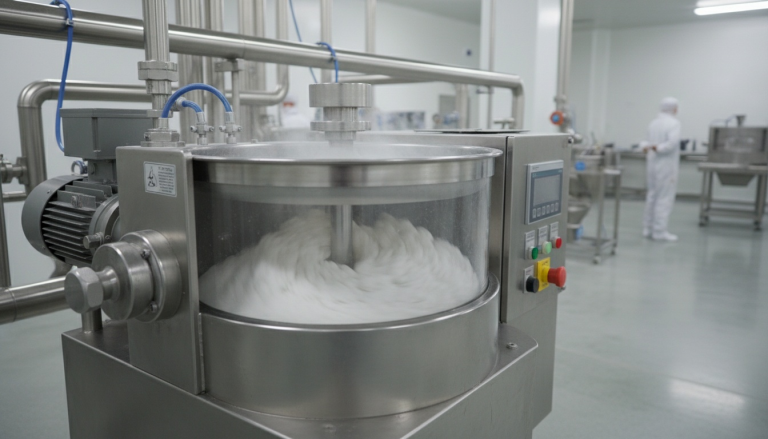
The first time I saw a high shear mixer working, I was shocked. That unassuming metal tank spun at thousands of RPM. It turned separated powder and liquid into uniform paste instantly. A Reddit user nailed it: “It’s like a kitchen blender on steroids.”
Why Can’t Pharma Live Without This Beast?
There’s a great Quora question: “Why spend hundreds of thousands on what looks like a giant blender?” The top answer came from an engineer at a Pharmaceutical Equipment Manufacturer. He worked there 15 years. His response was blunt:
“Because uneven mixing kills people.”
Sounds dramatic, but it’s true. If active ingredients distribute unevenly in tablets, some pills won’t work. Others might overdose patients. The first delays treatment. The second causes toxicity. High shear mixers exist to prevent this. They use extreme shear force to tear materials apart. Then they recombine everything uniformly. Every gram contains identical composition.
What Makes It So “Brutal”?
Traditional mixers use gentle tumbling. They work like kneading dough. High shear mixers are different. They have a rotor spinning at high speed. A stationary stator surrounds it. Together they form a “shear gap.” When materials enter this space, they experience:
- Tearing: Rotor edges move at 50 m/s. They rip particle clusters apart directly.
- Collision: Materials crash together in tight spaces. This breaks them down further.
- Cavitation: Tiny vacuum bubbles form and collapse. The shockwaves pulverize micron-sized particles.
Someone on r/PharmaceuticalManufacturing described it perfectly: “Picture a microscopic hurricane eye. Everything gets shredded inside. Then it’s thrown out to remix.”
Pretty accurate.
Industry Horror Stories
Case One: The Vanishing Active Ingredient
A European pharma company used high shear mixing for wet granulation. Their final product showed low active content. Investigation revealed the problem. Their API degraded under high shear forces. This case appears repeatedly on Quora. It’s the classic example of “not everything suits high shear.”
They switched to modified equipment from the same Pharmaceutical Equipment Manufacturer. The new version had temperature monitoring and variable frequency control. Problem solved. But they wasted tons of raw materials first. Three months of production time went down the drain. The team still has nightmares.
Case Two: When Perfection Backfires
An anonymous Reddit user shared something worse. Their company wanted “perfect mixing.” They extended mixing time from 5 to 15 minutes. The result? Particles got over-sheared into ultra-fine powder. Flow properties became terrible. They couldn’t compress tablets at all.
“We spent three days cleaning equipment,” he wrote. “Another week revalidating process parameters. You should’ve seen the boss’s face.”
This explains why experienced Pharmaceutical Equipment Manufacturers emphasize one thing: High shear isn’t magic. Parameter optimization matters more than equipment.
Wet vs Dry Granulation: The Art of Choice
Quora’s “High Shear Mixers: Wet vs Dry Granulation” thread sparked heated debate.
Pro-wet arguments:
- “Wet method ensures granule strength. They won’t crumble during compression.”
- “For poorly soluble drugs, binder solutions improve dissolution.”
- “One machine handles mixing, granulation, and drying.”
Pro-dry counterarguments:
- “Wet method is too slow. Adding liquid, mixing, drying takes hours.”
- “For heat-sensitive or moisture-sensitive APIs, wet is disaster.”
- “Energy consumption and environmental costs are lower.”
This isn’t black and white. Most pharma companies I’ve seen choose based on product characteristics. But one thing’s certain: If you pick wet granulation, high shear mixers are basically your only option. Only they can mix and granulate uniformly in short time.
Common Pitfalls
1. Ignoring Blade Wear
A Reddit r/Manufacturing thread specifically addresses this. One user ran continuous production for two years. Never checked rotor blades. Wear exceeded 30% of original thickness. Mixing efficiency tanked.
“Worse yet, we blamed raw material batches,” he added. “Changed three suppliers for nothing.”
2. Cleaning Validation Nightmare
High shear mixers have complex structures. The gap between rotor and stator is mere millimeters. Cleaning is brutal. A tech support guy from a Pharmaceutical Equipment Manufacturer wrote:
“Every customer training, we hammer one point home. Poor cleaning means cross-contamination risk is higher than you think. After producing high-potency drugs especially. Trace API residue can ruin the next batch completely.”
His solutions include:
- Using CIP (clean-in-place) systems
- Regular endoscope inspections of dead zones
- Strict cleaning validation standards
3. The Parameter Copy-Paste Trap
A Quora answer with nearly 1,000 upvotes mentioned this. Many companies scale from lab to production by proportionally increasing mixing time and speed. Product quality ends up completely different.
The reason? Shear force doesn’t scale linearly. Small equipment rotors might be 10 cm diameter. Production-scale could be 50 cm. At identical speeds, edge velocity differs fivefold. Professional Pharmaceutical Equipment Manufacturers provide scale-up guidance. They help clients re-optimize parameters.
The Future: How Much Can Smart Tech Solve?
Recently saw discussions about “smart high shear mixers.” Interesting stuff. Someone on Reddit asked: “Can sensors and algorithms really beat experienced operators?”
Supporters argue:
- Real-time torque, temperature, power monitoring enables early warnings
- Historical data models automatically adjust parameters
- Reduces human error and ensures batch consistency
Skeptics have valid concerns:
- “What if sensors fail?”
- “Algorithms train on normal conditions. What about extreme situations?”
- “Equipment costs double. Can small companies afford it?”
My take? Automation is inevitable. But it won’t replace human experience completely. Like self-driving cars still need human drivers. However smart equipment gets, process experts must make final decisions.
Three Tips for Newcomers
If you’re new to high shear mixers or considering purchasing equipment:
- Don’t focus only on price: Cheap equipment cuts corners on materials, seals, control systems. Maintenance costs will haunt you. Find a reliable Pharmaceutical Equipment Manufacturer. Ask about their client references.
- Lab → pilot → production, skip no steps: Figuring out parameters on production equipment costs too much. Rent pilot equipment for scale-up studies if possible.
- Maintain equipment files: Record production parameters, maintenance logs, cleaning validation results every time. This data is lifesaving during equipment failures or audits.
A Reddit meme suddenly comes to mind. Someone called high shear mixers “pharma’s macho man.” Simple and brutal, but damn effective.
Pretty much sums it up.