
Nauta Mixers: Why It Sets the Standard for Solid Dosage Equipment
I saw a post on Reddit’s r/pharma forum once. Someone complained about their old V-type mixer. They said mixing took so long they could finish a whole coffee. That’s when I realized mixing equipment matters more than most think.
Picture this: a pharma factory makes hundreds of thousands of tablets daily. If powder uniformity is off by just 0.1%, it could mean reduced efficacy. It might even cause safety issues. That’s where Nauta Mixers come in. They’re like precision instruments for the mixing world.
Why Is Pharma So Picky About Mixing Equipment?
There’s a popular Quora question: “Why is pharmaceutical mixing so critical?” The top answer came from a process engineer at Johnson & Johnson. He worked there for 15 years. His response really stuck with me:
“Mixing isn’t just dumping two powders together and stirring. Active pharmaceutical ingredients (API) usually make up only 1-5% of the formula. The rest is excipients. Poor mixing means some tablets have too much API. Others have too little. This isn’t a joke.”
This reminded me of a recall from a major Chinese pharma company. They blamed “quality fluctuations.” Really, their mixing equipment couldn’t keep up.
A QA manager posted on Reddit’s r/QualityAssurance board. It was pretty honest. He said: “Our old planetary mixer had dead spots in corners. Every time we tested content uniformity, we held our breath. We switched to a Nauta Mixer. Our RSD dropped from 8% to 1.5%. FDA audits became way easier.”
What Makes Nauta Mixers Special?
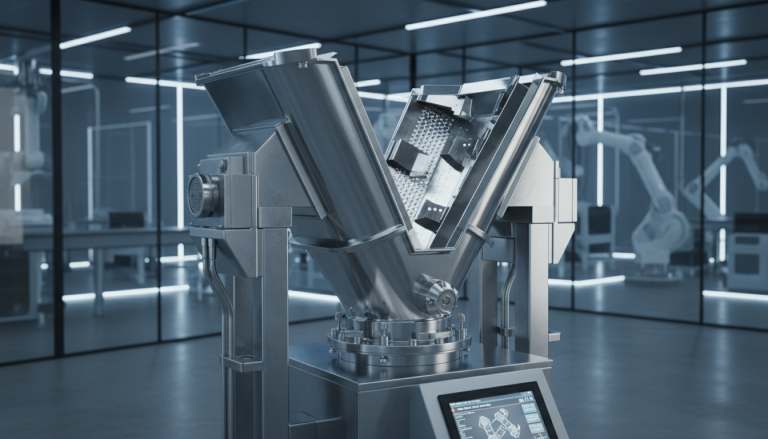
As an experienced Solid Dosage Equipment Manufacturer, Nauta has a core design philosophy. It can be summed up in three words: three-dimensional convective mixing.
1. Conical Container Plus Screw: The Golden Combo
Unlike traditional mixers that use “violent tumbling,” Nauta’s design is clever:
- Conical container: The pointed bottom makes materials naturally converge toward the center. No hidden dead zones.
- Screw auger: It doesn’t stay fixed on a central axis. It orbits along the container wall while rotating. Like a planet orbiting the sun while spinning.
What makes this design brilliant? Powder moves up and down. It also flows left, right, forward, and back. A chemical engineer on Quora put it well: “It’s like a tornado inside a cone.”
2. Gentle Mixing That Protects Fragile Materials
There’s an interesting discussion on Reddit’s r/ChemicalEngineering board. The topic was “high shear vs. low shear mixing.” A nutraceutical engineer shared this:
“Our formula contains probiotic powder. High-speed mixers killed the live bacteria. After switching to Nauta, mixing was slower. But strain survival rate increased by 40%.”
That’s absolutely true. Nauta’s screw typically spins at only 30-60 RPM. That’s way slower than high-shear mixers running at hundreds or thousands of RPM. This “slow and steady” approach works great for:
- Fragile granules (like sustained-release pellets)
- Heat-sensitive materials (high-speed friction generates heat)
- Wet granulation processes with moisture content
3. A Dream for Cleaning Validation
FDA has an intense requirement for pharma equipment: Cleaning Validation. Simply put, you must prove your equipment is clean. You need to show no residue from the previous batch remains.
Nauta Mixer is practically “cheat-level” here:
- Smooth conical interior with no dead spots
- Screw can be completely removed
- All product-contact parts are 316L stainless steel (corrosion-resistant and easy to clean)
A validation engineer shared on Quora: “Traditional mixers require 20 swab samples. Nauta needs only 8. Cleaning time went from 4 hours to 1.5 hours.”
Real-World “Complaints” and “Praise”
Of course, no equipment is perfect. There’s a Reddit r/pharma post titled “Nauta Mixer is great, but…” The complaints were pretty focused:
Complaint 1: Not Cheap
“Our boss nearly jumped when he saw the quote. One 200-liter Nauta costs as much as three V-type mixers.”
But a reply made sense: “Factor in labor, energy, and waste rates. It pays for itself in three years. Cheap equipment is actually more expensive.”
Complaint 2: Not Suitable for All Materials
A veterinary pharma engineer mentioned: “We have a formula with ultrafine powder plus large particles. After Nauta mixing, large particles still settled. We had to add anti-settling agents.”
This isn’t really Nauta’s fault. It’s physics. Materials with huge density differences naturally segregate. A materials scientist on Quora explained: “No mixer can defy gravity forever.”
Complaint 3: Maintenance Requires Professional Training
“After the screw bearing seal wore out, we tried replacing it three times. Powder kept leaking. Finally, we called the factory technician.”
But this actually shows Nauta’s high precision requirements. Good equipment needs people who understand it.
Future Trends in Pharmaceutical Mixing Machines
Under Quora’s “Future of pharma manufacturing” topic, several trends stand out:
1. Smart Monitoring
Modern Nauta Mixers now feature NIR (Near-Infrared Spectroscopy) sensors. They monitor blend uniformity in real-time. A process engineer on Reddit was excited: “We used to judge mixing time by experience. Now the equipment tells you ‘OK, ready to discharge.’”
2. Modular Design
As a leader in Pharmaceutical Mixing Machine technology, Nauta launched integrated “mixing-granulation-drying” equipment. An equipment engineer commented: “We used to transfer material three times for three steps. Now one vessel does it all. Contamination risk dropped dramatically.”
3. Continuous Manufacturing
While Nauta traditionally operates in batch mode, the latest generation enables quasi-continuous feeding. This comes up repeatedly in Quora’s “Continuous manufacturing in pharma” discussions. FDA strongly promotes continuous manufacturing. Equipment must keep pace.
Choosing a Mixer Means Choosing “Certainty”
At first, I thought mixing equipment was just a metal tank with a stirrer. But I learned pharma doesn’t want something that “can mix.” They need something that “mixes the same way every time.”
Nauta Mixers’ core competitiveness is achieving this certainty to the extreme:
- Same formulation mixed 10 times or 10,000 times. RSD stays within 2%.
- Different raw material batches (slightly different particle size, flowability). Mixing results stay controlled.
- From 50 kg pilot scale to 2,000 kg production. Process parameters scale linearly.
A Reddit post ending really moved me: “In pharma, consistency is not boring, it’s life-saving.”
Final Thoughts
If you’re choosing a Solid Dosage Equipment Manufacturer right now, consider Nauta. If you’re evaluating Pharmaceutical Mixing Machines, definitely put it on your list.
But don’t worship it blindly. Even the best equipment needs proper formulation design. It needs operators who understand it. It needs strict process validation. As a veteran engineer said on Quora: “A Nauta mixer doesn’t make bad formulations good, but it makes good formulations consistent.”
What’s sobering is this: every little pill we swallow daily. Behind it might be precision equipment like this silently protecting us. Next time you take a pill, maybe show some respect for pharmaceutical processes.