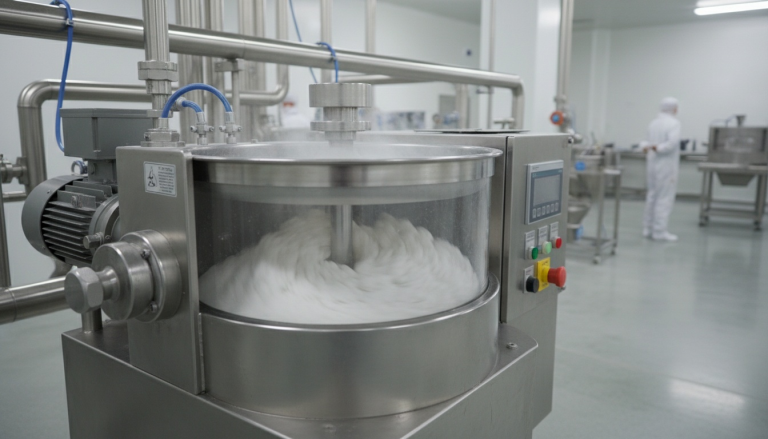

Planetary Mixers: The Pharmaceutical Industry’s “Secret Weapon”? Real Users Speak Out
At 3 AM, a pharmaceutical engineer posted on Reddit: “Our new planetary mixer finally arrived today. But I’m staring at the manual now. Completely lost on where to start…”
The post quickly gathered over 200 replies. Some shared horror stories. Others posted detailed setup parameters. One veteran bluntly said: “Bro, did you pick the right Solid Dosage Equipment Manufacturer? That matters more than knowing how to use it.”
Honestly, I thought mixers were simple at first. Just blend powders evenly, right? Then I saw a Quora question: “Why do pharmaceutical companies spend $100K+ on a mixer when a $500 kitchen mixer looks the same?”
The answers completely changed my perspective.
1. What Makes Planetary Mixers Actually “Planetary”?
Technical Explanation from Quora
A Pfizer engineer with 15 years’ experience described it this way:
“Imagine our solar system. The sun spins at center. Planets orbit the sun. Meanwhile, planets also rotate on their own axes. Planetary Mixers work exactly like this. The mixing blade (planet) revolves around the container’s central axis. At the same time, it spins rapidly on its own. This dual motion creates ‘three-dimensional shearing.’ Regular mixers can’t do this.”
He added a crucial detail:
“The biggest difference between Pharmaceutical Mixing Machines and food industry equipment? We require mixing uniformity of RSD < 5% (relative standard deviation below 5%). One percentage point off? That means uneven active ingredient distribution. Patients get wildly different drug effects.”
Makes sense.
Reddit’s “Disaster Stories”
But Reddit’s r/pharmaceuticalengineering forum has a different vibe.
One user complained: “We bought a cheap used planetary mixer. Our first batch got rejected by QA immediately. Powder color was uneven. Cut open the tablets—all active ingredients settled at bottom. Later we learned the machine’s blades were worn. Speed was unstable too.”
Someone replied: “That’s why choosing Solid Dosage Equipment Manufacturers can’t be about price alone. Legit vendors provide IQ/OQ/PQ validation documents. Those documents save your ass during FDA audits.”
This reminded me… pharmaceutical production isn’t a “close enough” industry. Every machine must be traceable. Verifiable. Repeatable.
2. Hidden Talents of Planetary Mixers
Not Just Mixing—Also Granulating and Coating
A high-rated Quora answer blew my mind:
“Many don’t know this. High-end Planetary Mixers are actually ‘multitaskers.’ In pharma, one machine can handle:
- Dry mixing: Blend different powders (like API active ingredients plus excipients)
- Wet granulation: Add binder solution. Turn powder into granules (easier for tableting later)
- Coating: Apply protective film on granule surface (controls drug release rate)
One machine does three jobs. But here’s the catch—you must buy real Pharmaceutical Mixing Machines. Not generic ‘industrial grade’ models.”
Reddit Users’ “Money-Wasting Tales”
On r/biotech, one post title caught my eye:
“Spent $80K on a ‘versatile’ mixer, turns out it’s only good at one thing”
The poster detailed their company’s experience:
“We picked an unknown Solid Dosage Equipment Manufacturer. Sales pitch was amazing. But in actual use? Wet granulation caused severe wall sticking. Coating function was useless. After consulting major manufacturers, we understood. True multi-function models demand sophisticated blade design. Advanced sealing systems. Precise temperature control. Cheap stuff can’t deliver.”
One reply hit hard:
“Pharmaceutical industry is not the place to ‘learn by trial and error’. You pay upfront. Or you pay 10x later in batches, audits, and reputation.”
3. How to Judge if a Planetary Mixer is “Good Enough”?
Quora Expert’s “Five Must-Ask Questions”
A former FDA auditor shared his checklist:
1. Does material meet cGMP standards?
“Parts contacting materials must be 316L stainless steel or higher. I’ve seen companies use 304 stainless steel. When producing acidic drugs? Metal ions leached out. Way over limits.”
2. Can they provide complete validation documents?
“Any reliable Solid Dosage Equipment Manufacturer should offer:
- Design Qualification (DQ)
- Factory Acceptance Test (FAT)
- Site Acceptance Test (SAT)
Without these? Even great equipment is ‘undocumented.’”
3. Does cleaning validation pass?
“Pharma equipment’s biggest fear? Cross-contamination. Planetary mixer blades and container walls must detach easily for cleaning. Plus, cleaning effectiveness must be verifiable (residue < 10 ppm).”
4. How’s batch-to-batch repeatability?
“Same formula, same parameters, make 10 batches. Content uniformity must stay consistent. This tests mechanical precision and control system stability.”
5. Is after-sales service reliable?
“Equipment breaks down. Spare parts take 3 months to arrive? Your production line stops for 3 months. When choosing Pharmaceutical Mixing Machines, vendor service networks and parts inventory matter equally.”
Reddit’s “Pitfall Guide”
An r/pharma “veteran” posted a long summary of 20 years’ mistakes:
❌ Pitfall 1: Getting fooled by “European import”
“Not saying European equipment is bad. But some domestic agents package regular industrial equipment as ‘pharmaceutical-grade.’ Price triples. How to tell? Demand CE certification or FDA registration numbers. Check if manufacturer’s website has pharmaceutical product lines.”
❌ Pitfall 2: Ignoring capacity range
“Many companies bought 100L planetary mixers. Later found small-batch R&D (5-10L) didn’t mix evenly. Large-scale production (200L+) wasn’t enough capacity either. Plan capacity needs upfront.”
❌ Pitfall 3: Only checking specs, not testing
“Speed, power, torque—all in spec sheets. But actual mixing performance? Must bring your own materials to manufacturer for trial runs. Watch actual mixing time, energy consumption, temperature rise.”
One reply stuck with me:
“We once rejected a mixer that looked perfect on paper. During trial run, we noticed metal shavings in final blend. The manufacturer’s QC was a joke.”
4. Hidden Costs of Planetary Mixers
TCO Analysis from Quora (Total Cost of Ownership)
An MBA-trained pharma purchasing manager calculated:
“A Planetary Mixer’s full lifecycle cost includes:
- Equipment itself: $500K-$1.5M (depends on capacity and features)
- Installation and commissioning: 10-20% of equipment price
- Validation costs: $50K-$100K (includes third-party testing)
- Annual maintenance: 3-5% of equipment price
- Energy consumption: Medium-sized equipment costs $20K-$50K yearly in electricity
- Training costs: Operators and maintenance engineers need certification
So don’t just focus on purchase price. A machine 20% cheaper but with 50% higher failure rate? You’ll regret it in 5 years.”
Reddit’s “Real Case”
An r/manufacturing post title read:
“Our ‘cheap’ mixer cost us $2M in recalled batches”
The poster was a small pharma company’s COO:
“We saved $150K initially by choosing a small manufacturer’s equipment. Used it less than a year. Poor mixing caused 3 batches to fail. Forced recall. FDA fines plus destruction costs plus reputation damage? Over $2M loss total. Finally bit the bullet. Bought equipment from legit Solid Dosage Equipment Manufacturers.”
Someone commented:
“This is why big pharma companies have ‘approved vendor lists’. They’ve already paid the tuition for you.”
5. Future Trends: Automation and Continuous Manufacturing
Technology Outlook from Quora
A Roche R&D center engineer shared his observations:
“Next-gen Pharmaceutical Mixing Machines will integrate:
- Real-time NIR monitoring (near-infrared spectroscopy): Detect ingredient distribution while mixing. Stop when done.
- AI optimization algorithms: Auto-adjust speed and mixing time based on material properties
- Continuous production mode: Shift from traditional ‘batch production’ to ‘continuous flow.’ Efficiency jumps 10x.
But these technologies currently exist mainly among top manufacturers.”
Reddit’s “Cold Water”
But r/pharma had skeptics:
“Continuous manufacturing sounds great. But pharma regulation logic is built on ‘batch’ concepts. Each batch needs independent validation. Independent release. Until regulatory policies change? Even advanced technology stays in labs.”
Some pushed back:
“FDA already released Continuous Manufacturing guidelines. In 5-10 years, Planetary Mixers might shift from ‘primary equipment’ to ‘transition solution.’ But for small-to-medium enterprises? Traditional batch production remains mainstream for a long time.”
Final Thoughts
Back to that 3 AM engineer staring at the manual. He later updated his post:
“Thanks everyone for advice. We confirmed our supplier is a reliable Solid Dosage Equipment Manufacturer. Got complete validation documents too. Trial run went great today. First batch samples showed content uniformity RSD of only 2.3%. Boss is happy.”
Someone replied:
“Congrats! Now the real challenge begins—keeping it that way for the next 10 years.”
True that.
Choosing the right Planetary Mixer isn’t the endpoint. It’s the starting point. But at least it’s a good start.