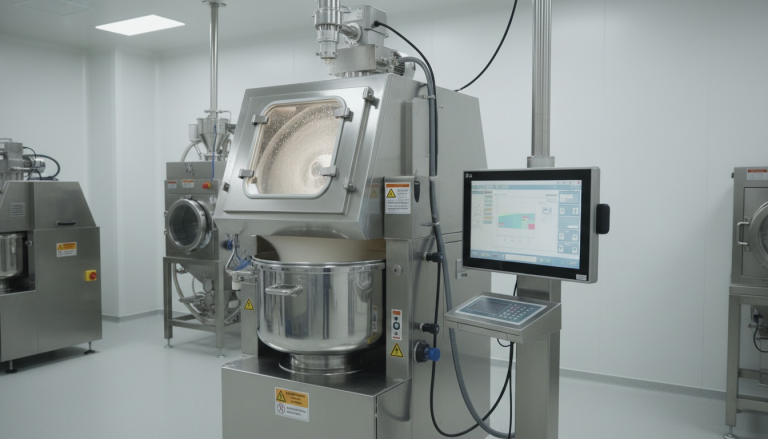

Precision Blending for Pharma and Chemicals: How Tumble Mixers Ensure Batch-to-Batch Uniformity
The Overlooked Tech Revolution
Ever wondered how pills, flour, or cosmetic powders get perfectly blended? Most people don’t. But behind that “I don’t know” lies decades of industrial evolution.
Tumble mixers quietly rewrite efficiency across global manufacturing. Pharma, food, chemicals, ceramics—they’re everywhere. Yet nobody talks about them. That’s by design. Great industrial equipment should be invisible. You focus on results, not machinery.
But things are shifting. Industry 4.0 is here. Product consistency standards keep rising. Cost pressures never stop. Tumble mixers aren’t just “tools that work” anymore. They’re becoming competitive differentiators.
What Is a Tumble Mixer?
Here’s the straight definition: A tumble mixer rotates a container to create tumbling motion. This blends powders and granular materials.
Sounds simple. It’s not.
Traditional high-shear mixers use brute force. Spinning blades crush everything. Fragile particles? Destroyed. Product quality? Compromised.
Tumble mixers take a different path. They use gravity and tumbling action. Materials flow and reorganize naturally inside the container.
How does it actually work? The container spins around a central axis. Materials experience “rolling and cascading” motion. Picture sand and pebbles in a tilted, rotating cylinder. Every rotation redistributes the mixture. That’s the core logic.
Here’s the genius: No internal agitators. No high-speed blades. Just container geometry and gravity. Less mechanical wear. Lower energy consumption. Gentler mixing. For expensive, sensitive pharmaceutical ingredients? This is a lifesaver.
Many Forms, Each With Strengths
Tumble mixers aren’t one product. They’re a whole family. Understanding this diversity explains their cross-industry dominance.
- Rotary Drum Mixers: The simplest form. A spinning cylinder. Materials tumble continuously. Simple structure. Low cost. Perfect for large-scale operations. Downside? Lower mixing efficiency. Longer cycles. That’s why mining and agriculture love them.
- V-Blenders: A clever geometric innovation. Two cylinders arranged in a V-shape. Materials alternate between both cylinders. This complexity boosts uniformity significantly. Ideal for precision-demanding applications—like pharmaceuticals.
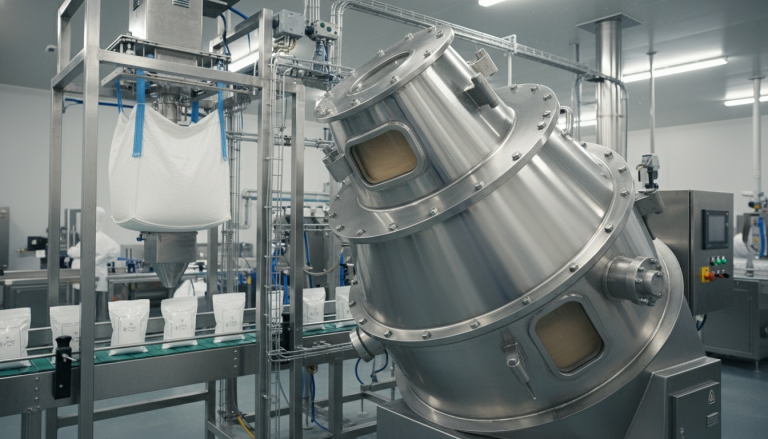
- Double Cone Mixers: Designed for ultra-gentle mixing. Two cones connected at their bases. Material rolls from one cone to the other. Standard equipment in pharma and fine chemicals. It delivers thorough mixing while protecting product integrity.
- Alphie Mixer: A fascinating innovation. It adds a third dimension of motion. Not just rotation—tumbling too. The container moves in and out twice while rotating around a secondary axis. Different planes of motion. Result? Dramatically faster mixing. Efficiency skyrockets. This is what progress looks like: 2D thinking upgraded to 3D.
Why Does This Matter Now?
1. Mandatory Product Consistency
If you’re a pharma company, batch-to-batch concentration variance triggers FDA scrutiny. That’s not a suggestion. It’s law.
Tumble mixers nail this. Gentle diffusion mixing achieves highly uniform distribution. Zero material degradation. For million-dollar drug batches, this gentleness isn’t luxury. It’s survival.
2. Energy Costs and Sustainability Pressure
Industrial energy keeps eating into manufacturing costs. Tumble mixers consume significantly less energy than high-shear alternatives. Over ten years of operation? The savings hit millions. With electricity prices rising and carbon taxes coming, low-energy equipment wins.
3. Customization and Small-Batch Production
Industry 4.0 demands mass customization. Companies need fast product switches. Small batches. Tumble mixers deliver flexibility. No complex cleaning procedures. No lengthy warm-up or calibration. Load new materials. Flip the switch. Start immediately. For manufacturers adjusting product lines frequently? This agility is priceless.
What Does This Mean?
For Manufacturers: A New Competitive Dimension
Still using old high-shear mixers? You’re probably wasting money in three areas: energy, product loss, and production time.
Tumble mixer ROI typically hits within 2-3 years. More importantly, you gain an invisible edge: more stable product quality. At equal prices, your consistency beats competitors. In B2B markets, that’s massive differentiation.
For Supply Chain Players: Rethink Procurement Decisions
You’ve been comparing supplier prices. But price-only comparisons miss a critical metric: mixing uniformity stability.
Can your supplier hold concentration within tight tolerance? Or does it fluctuate wildly? The downstream cost impact is huge. Tumble mixers help suppliers achieve the former. Worth specifying in your contracts.
For Equipment Makers: New Innovation Directions
What does Alphie prove? Even “mature” technology fields have massive innovation potential.
3D motion. Real-time sensor integration. Automated controls. These are future directions. If you manufacture mixing equipment, ask yourself: What smart features should your next-generation products have?
What Should You Do?
- Audit your mixing process. Be honest. How much waste exists? What’s your product loss rate? Can mixing time shrink? Have you tracked energy consumption? What’s your batch-to-batch consistency range? Any subpar metric means tumble mixers deserve investigation.
- Run small-scale trials. Don’t commit big capital upfront. Many manufacturers offer rentals or trials. Test with your actual materials and formulas. Find the sweet spot between mixing time and uniformity.
- Calculate real ROI. Don’t just look at purchase price. Calculate Total Cost of Ownership. Include initial investment, annual energy costs, maintenance, reduced product loss, and productivity gains from less downtime. This calculation often transforms decisions completely.
- Build quality monitoring systems. New equipment alone isn’t enough. Establish data-driven quality control. Measure, record, and analyze uniformity for every batch. This optimizes your process. It also powers your marketing and sales.
- Watch for the next innovation wave. The tumble mixer story isn’t over. IoT, AI, and real-time sensing are maturing. Next-gen mixers will get smarter. When investing now, prioritize upgradeable equipment with open ecosystems.
Conclusion
If you’re in manufacturing, it’s time to notice these “invisible heroes.”
Game-changing breakthroughs rarely come from flashy new tech. They come from deep understanding and smart application of existing solutions.
Tumble mixers never exploded overnight. But their evolution—from simple drums to V-types to double cones to precision 3D motion—proves an eternal industrial truth: Efficiency and quality boundaries can always be pushed.
The only question is: Have you spotted this opportunity?