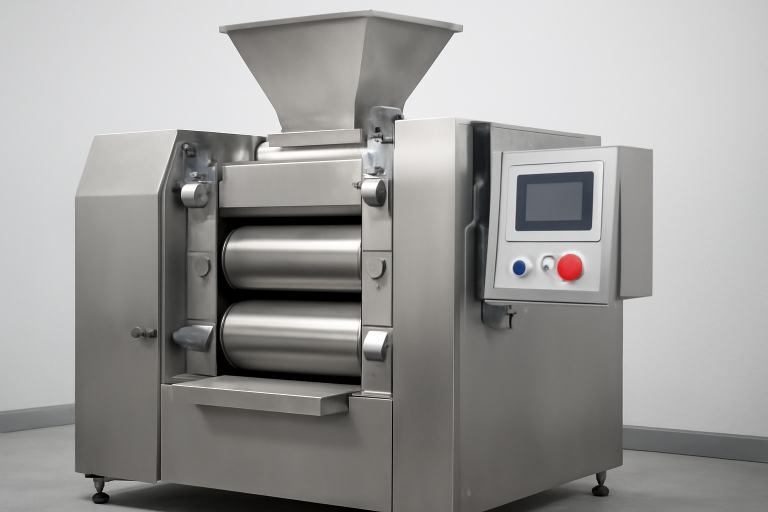

The “Hidden Champion” in Pharma Equipment: Why Oscillating Granulators Always Get Underestimated
Opening: An Overlooked Soul of the Pharma Workshop
Ask people in pharma about the most important equipment. Nine out of ten will say tablet presses or coating machines. These are the “star machines.” But there’s one device that’s the real hero behind the scenes. It’s the Oscillating Granulator.
This reminds me of a post on Reddit’s r/PharmaceuticalManufacturing. A quality engineer complained about something frustrating. They spent hundreds of thousands on an advanced tablet press. Then an entire batch got scrapped. The problem? The granulation step went wrong. Turned out, their overlooked oscillating granulator had wrong parameter settings.
This isn’t an isolated case. Search “pharmaceutical equipment failures” on Quora. You’ll find something shocking. Granulation errors cause more losses than any other single process. What’s scary? Many companies don’t even know how to choose equipment for this step.
Part 1: What Does an Oscillating Granulator Actually Do? (Don’t Let Technical Terms Fool You)
Reddit’s “Plain English” Explanation Works Best
There’s a top-voted answer on r/AskEngineers. It uses a great analogy:
“Imagine making cookies. Dough too wet won’t hold shape. Too dry crumbles into powder. The oscillating granulator is like a ‘dough shaper.’ It pushes sticky wet material through a screen. This creates evenly sized granules. These granules won’t stick or create dust. Perfect for the next tableting step.”
In technical terms, its functions are:
- Wet granulation post-processing: Breaking wet lumps into uniform granules
- Dry granulation sizing: Re-crushing compressed material to proper particle size
- Tablet rework: Turning rejected tablets back into granules
But the core idea is simple: It turns raw materials from “a mess” into “obedient soldiers.”
Part 2: Why Are Solid Dosage Equipment Manufacturers Obsessed with This Machine?
Here’s an industry truth many people don’t know.
A Quora Engineer’s Perspective Changed My View
An engineer worked 15 years at a European Solid Dosage Equipment Manufacturer. He shared some striking data:
- 80% of oral drugs worldwide need granulation
- Granulation quality directly affects 5-7 downstream production steps
- Adjusting one oscillating granulator’s parameters can boost line efficiency by 30%
He said something that hit hard:
“Many pharma companies buy the priciest tablet press. They want the smartest coating machine. But the oscillating granulator? ‘Good enough’ is fine. The result? Advanced tablet press, uneven granules fed in. Still produces rejects.”
This isn’t a technical problem. It’s a perception problem.
What Are Top Solid Dosage Equipment Manufacturers Fighting For?
I compared several industry-leading manufacturers. Names like GEA, IMA, and Alexanderwerk. Their R&D investment in oscillating granulators matches “star equipment.” The reason is simple:
It’s the only “make-or-break” intermediate step.
- Upstream: Bad granulation wastes mixing and granulating
- Downstream: Uneven granules ruin tableting and coating
Top Solid Dosage Equipment Manufacturers obsess over these details:
- Screen design: Regular makers use standard mesh. Top makers customize hole patterns for material properties
- Oscillating rotor: Speed, amplitude, blade angle all matter. Reddit has posts discussing “why 45° blades beat 30° blades”
- Cleaning validation: GMP certification hinges on “can you clean it completely”
Part 3: Real Case: The “Butterfly Effect” from One Machine
A Disaster Story from Reddit
There’s a post on r/manufacturing titled “Why we spent $80k replacing a ‘working’ granulator.”
The poster manages production at an Indian generic drug company. They used a 10-year-old oscillating granulator. “Old but functional.” Then a new antibiotic formula gave trouble. Tablets wouldn’t compress right. Either too hard with slow disintegration. Or too brittle and cracking.
They finally found the issue: Worn screen mesh caused uneven particle distribution. Too many fine particles made tablets over-compressed. Too many coarse particles couldn’t handle pressure.
After getting new equipment, good product rate jumped from 78% to 96%. Even coating step losses dropped 20%.
This case shows: Not all “functional” equipment deserves modern production lines.
Quora Expert’s Addition: Choose Equipment by “Ecological Position”
A process engineer who worked at Pfizer added an angle:
“Choosing an oscillating granulator isn’t just about single-machine performance. Consider its ‘ecological position’ in the line. Say upstream uses high-shear mixer-granulator. Downstream uses high-speed tablet press. Then granulator output speed and particle strength must match both ends’ rhythm.”
This explains why reliable Solid Dosage Equipment Manufacturers offer “complete line solutions.” Even great standalone machines create disasters without proper coordination.
Part 4: Overlooked “Pitfalls” (Must Read Before Buying)
Pitfall 1: Looking Only at Price, Not TCO (Total Cost of Ownership)
This gets the most Reddit complaints. Cheap equipment saves money initially. But:
- Screens need replacing every 3 months (expensive ones last a year)
- No auto-cleaning means 2-hour teardowns for product changes
- Spare parts only from OEM, costing 3x generic parts
One reply was brutal: “Buying cheap is like renting. Looks cost-effective. Five years later costs more than buying.”
Pitfall 2: Ignoring GMP Compliance
Quora pharma regulatory experts emphasize this repeatedly. If oscillating granulator design doesn’t meet GMP:
- Dead spots prevent cleaning validation
- No cross-contamination prevention contaminates products
- Incomplete documentation fails FDA inspection
Choosing qualified Solid Dosage Equipment Manufacturers isn’t overspending. It’s avoiding landmines.
Pitfall 3: Underestimating Operator Training Importance
This seems counterintuitive. Equipment automation doesn’t eliminate human factors.
A Reddit post shared experience: “We bought top German equipment. Operators couldn’t adjust parameters. Got domestic machine performance. Then manufacturer sent engineers for 2-week onsite training. Finally achieved true capability.”
So when choosing Solid Dosage Equipment Manufacturers, after-sales service and training systems are hard requirements.
Part 5: Future Trends: The “Intelligence” Revolution in Oscillating Granulators
Industry Direction Has Shifted
A Quora trend discussion was fascinating: Future oscillating granulators will “think for themselves.”
Top Solid Dosage Equipment Manufacturers are doing this now:
- Online particle size monitoring: Real-time speed adjustment ensures uniform granules
- AI predictive maintenance: Warns you “screen needs changing” 3 weeks ahead
- Digital twin technology: Test formulas in virtual environment before actual machine
This isn’t science fiction. IMA and GEA’s new models already have these features.
But Some Pour Cold Water
A Reddit veteran made a practical point:
“Technology advances, but basic principles remain. Material still gets broken up through screens. Don’t get fooled by fancy features. Core still comes down to screen quality, rotor design, overall stability. Intelligence is icing on cake, not a lifeline.”
Very true.
Conclusion: The “Hidden Value” of Pharma Equipment
Writing this reminded me of a 2000+ upvote Quora answer:
“Pharma’s biggest mistake? Treating equipment as cost, not investment. A good oscillating granulator saves 10 times its purchase price over 10 years.”
Next time someone asks “what pharma line equipment deserves investment most,” I’ll say without hesitation:
Find a reliable Solid Dosage Equipment Manufacturer. Buy an oscillating granulator truly right for you.
Not the priciest. The rightest.