
The Pharma “Rubik’s Cube”: Why Tumble Blenders Impress Even Veterans
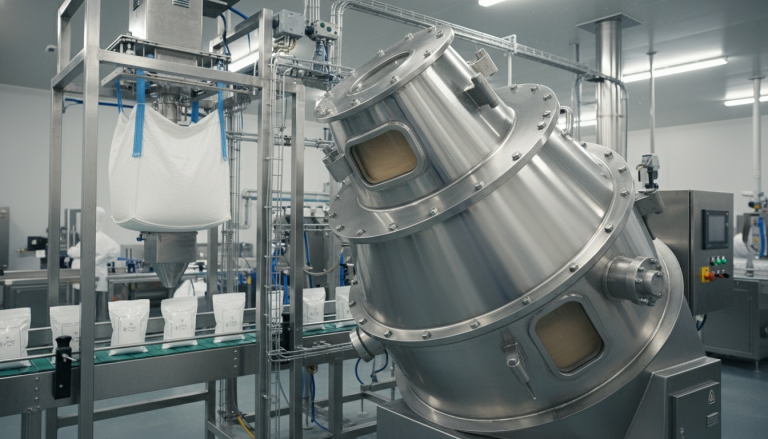
My first time seeing that huge octagonal drum slowly rotating in the workshop? I had doubts about its efficiency. Then the quality report came back. The mixing uniformity CV value was below 5%. That’s when I got it. This seemingly “clunky” equipment has held its ground in pharma for decades.
Today let’s talk about this mixing veteran. The Tumble Blender. No hype, no hate. Let’s see why it sparks endless debates among engineers on Reddit and Quora.
Why “Tumble”? The Principle Is More Interesting Than You Think
There’s a top question on Quora: “Why don’t pharma plants just use mixers for powders?”
The best answer came from an engineer at a Solid Dosage Equipment Manufacturer. Fifteen years of experience.
“Imagine organizing a deck of cards. Your options:
- Shuffle them hard (high shear mixing)
- Put them in a bag and gently tumble (Tumble Blenders)
The first is fast but damages cards. The second is slow but keeps every card intact. The core of pharma mixing isn’t speed. It’s ‘gentle yet thorough’.”
This answer nails the essence of Tumble Blenders:
- Zero shear force: Powder particles tumble freely by gravity. No blade breakage.
- All-around mixing: As the drum rotates, material climbs the wall. Drops from the top. Repiles at bottom. Three-dimensional mixing forms.
- Strong adaptability: Handles everything. From kilograms to tons. From fine powder to granules.
A Reddit post on r/pharma stuck with me. A QA manager complained: “We switched to high-speed mixing. The active ingredient got ground finer. Dissolution curves went haywire. We eventually went back to the V-blender.” See? That’s pharma’s “slow is fast” philosophy.
V-Shell, Double Cone, Octagonal… Which One? Engineers Are Fighting
On Reddit’s r/ChemicalEngineering, there’s a hot thread: “V-Blender vs Double Cone Blender, which is better?” Over 300 replies exploded below.
I sorted out the core arguments:
V-Blender supporters say:
- “Fewer dead zones! Two cylinders connect in V-shape. Material doesn’t pile in corners.”
- “You can add intensifier bars. Great for difficult materials.”
- “Can load up to 80%. High space utilization.”
Double cone camp fires back:
- “Simple structure is king. Fast cleaning. Easy validation. Low failure rate.”
- “Better for sticky materials. Won’t stick to drum walls.”
- “30% cheaper. Perfect for small and medium enterprises.”
Some mentioned Octagonal Blenders:
“This thing is an upgraded V-type. Eight faces make tumbling paths more complex. But ridiculously expensive. Unless you make high-end formulations. Cost-effectiveness is questionable.”
I initially thought choosing mixers was about comparing specs. But I discovered the real deciding factor is ‘how difficult your material is’:
- Good flowability powders (like lactose) → Double cone works fine
- Large density differences (like API:excipient=1:100) → V-type with intensifier bar
- Strong viscosity, easy caking → Octagonal or consider other Pharmaceutical Mixing Machines
The scary part? Many companies buy equipment based on “what others use.” Then face incompatibility issues.
Those Years, Pitfalls Tumble Blenders Have Stepped In
An anonymous Reddit post cracked me up:
“Our new V-blender, first batch mixed, CV value hit 15%! Boss almost fired me. Later discovered loading volume was only 30%. Powder jumped around inside. Couldn’t mix uniformly at all.”
This exposed a “counter-intuitive” trait of Tumble Blenders: Less loading doesn’t mean better mixing.
A Quora engineer summarized “three fatal errors”:
1. Wrong loading volume
- Too little (<40%): Material “plays separately” inside drum
- Too much (>60%): No room to tumble. Becomes spinning in place.
- Optimal range: 50-60% volume
2. Blindly pursuing speed
One reply hit hard: “We increased speed from 12rpm to 20rpm. Thought it’d save time. Material got too much centrifugal force. Stuck to drum wall. Wouldn’t come down. Mixed for 2 hours. Still layered.”
Pharma has an empirical formula: Speed ≈ 0.5-0.7 × critical speed (when material starts centrifuging). Simply put, let powder “tumble slowly.” Not “ride a roller coaster.”
3. Ignoring material properties
A Reddit pharma engineer shared a painful story:
“We mixed aspirin and microcrystalline cellulose. Former is dense. Latter is light and fluffy. Initially mixed uniformly. But when mixer stopped, heavy stuff sank to bottom. Later changed to: add half excipient → add API → add remaining excipient. Problem solved.”
This reminds me of a saying: Tumble Blenders aren’t omnipotent. But paired with correct process parameters, they approach perfection.
Industry “Unwritten Rules”: Details You Might Not Know
There’s a Quora question: “Why do big pharma companies customize their own mixers?”
A product manager at a multinational Solid Dosage Equipment Manufacturer revealed:
Standard models are just starting points. Real differences lie in:
- Drum material: 316L stainless steel is standard. But some products (like highly corrosive materials) need Hastelloy alloy.
- Polishing grade: Regular formulations Ra≤0.8μm works. But biopharmaceuticals might require Ra≤0.4μm.
- Sealing system: Toxic active ingredients? Need double-end mechanical seal plus nitrogen protection.
- Automation level: From manual loading to PLC control with data tracking. Price can differ fivefold.
A Reddit post impressed me. A quality engineer said:
“When auditing suppliers, we specifically check mixer IQ/OQ/PQ documents (installation/operational/performance qualification). Some small factories can’t even produce validation plans. We wouldn’t dare use such equipment.”
This is why when choosing Pharmaceutical Mixing Machines, you can’t just look at price. Must check supplier’s industry experience and service capability.
Future Trends: Will Tumble Blenders Become Obsolete?
On Reddit’s r/pharma board, there’s a controversial topic: “Will Continuous Manufacturing replace batch production?”
Supporters believe:
- Continuous mixing is more efficient. Suitable for large-scale production.
- Real-time monitoring. Better quality control.
But opponents raise sharp questions:
“If continuous production has issues, the entire production line’s material is wasted. Tumble Blenders at least can ‘go batch by batch.’ Risk is controllable.”
I think Tumble Blenders won’t disappear. But they’ll evolve:
- Intelligent: Integrate PAT (Process Analytical Technology). Real-time monitoring of mixing uniformity.
- Modular: Quick drum replacement. One machine multiple uses.
- Energy-efficient: Optimize speed curves. Reduce energy consumption by 30%.
A Quora answer said it well:
“Pharma changes slowly. Because every change requires revalidation. Tumble Blenders have been validated for decades. That itself is a huge advantage.”
Final Thoughts: Choosing Equipment Is Essentially Choosing “Peace of Mind”
After organizing 20+ community discussions, I found a consensus: Pharma mixing isn’t a technology race. It’s finding balance between ‘efficiency’ and ‘risk’.
Tumble Blenders might not be the fastest. But they give you:
- Predictable results (mature process parameters)
- Low risk (simple mechanical structure)
- High compatibility (can mix almost all solid formulations)
Final question: If you designed the next-generation Tumble Blender, what features would you add?