
The “Unsung Hero” of Pharma: Everything You Need to Know About Ribbon Blenders
Opening: An Accident That Made Me Think
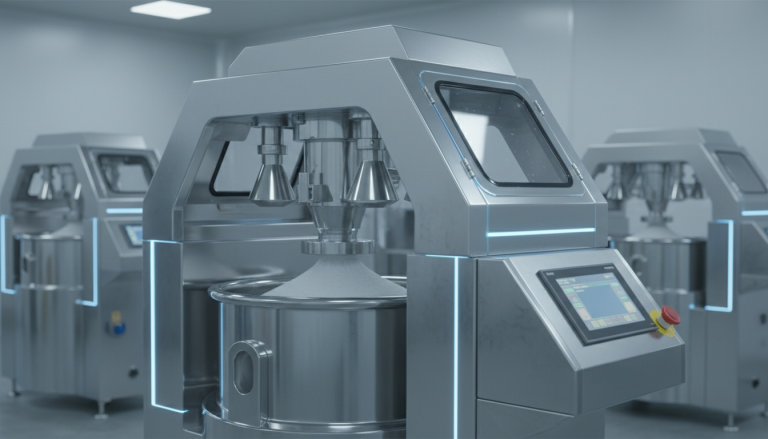
Last year I visited a pharma plant. Production manager Zhang stopped at a huge stainless steel machine. “You know what?” he said. “When this ribbon blender broke, our line stopped for 8 hours. We lost at least $70,000.”
He pointed at the seemingly simple machine. “Don’t let its looks fool you. In solid dosage production, this is the heart. Mix it wrong, and everything else fails.”
That made me curious. Why does a basic mixing device matter so much in pharma production? I dug through Quora discussions and Reddit’s r/pharma board. Found some interesting stuff.
Part 1: What Does It Mix? Why Does It Matter?
Professional Answers on Quora
I searched “ribbon blender pharmaceutical” on Quora. An engineer with 15 years in India explained:
“Ribbon blenders achieve three-dimensional powder mixing. Imagine this: API might be just 2% of the formula. But it must spread evenly in 98% excipients. Any local concentration difference causes unstable efficacy or side effects.”
He stressed one number: FDA requires mixing uniformity RSD ≤5%. Good ribbon blenders achieve ≤3%.
A QA manager from Canada mentioned:
- Dry mixing stage: Initial blending of excipients and binders
- Wet mixing stage: Mixing after adding binding liquid
- Final mixing stage: Final blend with lubricant after granulation
“All three stages might use ribbon blenders. But parameters differ completely. Speed, time, fill rate… every variable affects final quality.”
“Disaster Stories” on Reddit
On r/pharmaceuticalmanufacturing, one post title says it all: “Our ribbon blender almost killed a batch – lesson learned”
The poster, a US generic drug tech, shared a scary experience:
- New formula’s lubricant (magnesium stearate) added 2 minutes late
- Caused over-lubrication in some areas
- Tablet hardness failed specs
- Root cause: wrong PLC program parameters in the Pharmaceutical Mixing Machine
Comments exploded. People shared similar experiences:
- “Worn ribbons extended mixing time 30%. All disintegration times failed.”
- “Worst is incomplete cleaning causing cross-contamination. One batch’s residue affected the next.”
But optimism exists too. One veteran said their 20-year-old ribbon blender “beats new equipment when maintained properly.”
Part 2: Why “Ribbon”? What Secrets Hide in the Structure?
The Magic of Ribbon Design
A mechanical engineer on Quora described the setup clearly:
Outer ribbon: Rotates slowly, pushes material from ends to center
Inner ribbon: Rotates opposite direction, pushes center material to ends
Result: Creates “convection + shear + diffusion” triple mixing mechanism
He noted something counterintuitive:
“Many think faster speed means faster mixing. Wrong. Excessive speed creates ‘dead zones’ where material doesn’t move. Optimal speed is usually 20-40 rpm.”
Someone on Reddit asked: “Why not use V-blenders or double cone blenders?”
An experienced pharma worker answered practically:
- V-blender: Good for fragile materials, but slow
- Double cone: Gentle but inefficient
- Ribbon blender: Best value, works for 80% of solid dosage scenarios
“Unless you’re doing high-end biologics or nano powders, ribbon blenders are enough.”
Part 3: Selection Pitfalls and Treasures
Bigger Isn’t Always Better
A sales director from a Solid Dosage Equipment Manufacturer on Quora revealed:
“We’ve seen clients buy 2000L equipment but only mix 500L batches. This wastes energy and hurts mixing. The material layer is too thin. Ribbons can’t reach it.”
His experience formula:
- Working capacity = Total volume × 40%-60%
- For example, a 1000L blender suits 400-600L batches
Hidden Costs of Material Choice
An interesting Reddit post: “SS304 vs SS316L for ribbon blender – worth the extra cost?”
Heated debate:
- 304 stainless camp: “304 works for regular tablets. Why not save 30%?”
- 316L camp: “304 corrodes with chlorides or acidic excipients. Repair costs exceed initial savings.”
Top answer from an equipment engineer:
“Depends on your product line. For routine oral solids, 304 works. For corrosive products like effervescent tablets or antibiotics, go 316L directly.”
One detail mentioned: Contact parts (ribbons, inner walls) must be 316L. But outer shell can be 304 to cut costs.
Part 4: “Art” and Science in Use
Does Charging Order Really Matter?
A Quora question has 47 answers. Core debate: charging sequence.
Science camp (from a PhD formulator):
- Add large proportion excipients first (like microcrystalline cellulose)
- Then add API and minor excipients
- Finally add lubricant (with strict time control)
“This prevents light components floating or heavy components settling.”
Experience camp (30-year veteran):
“Theory is right. But in production, we run small trials. We test different sequences with the Pharmaceutical Mixing Machine. Some formulas work better in reverse order.”
A Reddit summary nailed it:
“No universal rule. Each formula is unique. But one iron law: Lubricant always last, never exceed 3 minutes.”
The “Soul Question” of Cleaning Validation
On r/QualityAssurance, a post titled: “How paranoid should I be about ribbon blender cleaning?”
An FDA inspector’s perspective:
“Most common problems we find:
- Residue in ribbon inner corners
- Powder buildup at bearing seals
- ‘Invisible contamination’ at discharge ports”
Someone shared their plant’s practices:
- Vacuum + compressed air after each batch
- Weekly wipe with 70% ethanol
- Monthly ribbon removal for deep cleaning
- Quarterly residue testing (HPLC or TOC)
“Sounds troublesome. But beats an FDA warning letter.”
Part 5: Future Trends: Smart and Modular
Automation Upgrades
A hot Quora discussion on “Industry 4.0 in pharma” mentioned ribbon blender intelligence:
- Real-time monitoring: NIR probes track mixing uniformity
- Adaptive control: Auto-adjusts speed and time based on material properties
- Data traceability: Complete parameter records for each batch for deviation investigations
A German engineer said: “Our new plant uses smart blenders from a Solid Dosage Equipment Manufacturer. System auto-judges if mixing meets specs. Continues if not. Minimizes human error.”
Rise of Modular Design
A Reddit thread discussed “single-use equipment vs multi-purpose equipment”:
- Traditional view: Multi-use saves investment
- New trend: Modular design, dedicated equipment per product line
“Our plant now has 3 small ribbon blenders. Each for regular tablets, coated tablets, and high-potency APIs. Initial investment is higher. But zero cross-contamination risk. Cleaning validation is simpler too.”
Conclusion: Don’t Underestimate This “Metal Barrel”
Honestly, before writing this, I saw Pharmaceutical Mixing Machine as “just a mixer.” But deeper research revealed it’s comprehensive. It combines materials science, fluid mechanics, and quality management.
A Quora quote says it well:
“A good ribbon blender doesn’t make you rich, but a bad one can bankrupt you.”
For pharma companies, choosing a reliable Solid Dosage Equipment Manufacturer matters. Establishing solid SOPs matters. Proper daily maintenance matters. These “boring” tasks are the foundation of quality stability.