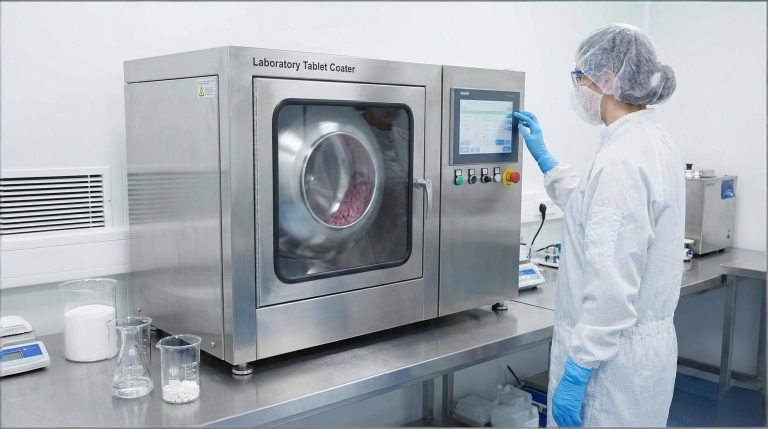

Why Perforated Pan Coaters Are Now the Industry Standard for Pharmaceutical Coating
Why Did a “Pan With Holes” Become Industry Standard?
If you work in solid dosage forms, you’ve noticed a clear trend. New production lines? Renovations? Everyone’s picking perforated pan coaters. Old-style solid pans only survive in outdated facilities or teaching labs.
At first glance, both seem similar:
A rotating drum. Spray on one side. Hot air on the other. Dry the coating.
But here’s the truth. Perforated pans are an upgraded version of airflow and thermal engineering. They massively impact coating quality, consistency, production costs, and safety compliance.
Where’s the conflict?
- Equipment vendors say: Perforated pans are efficient, modern, and standard. Don’t fall behind.
- Senior engineers say: Solid pans work fine. Cheaper to maintain. No need to switch.
- Quality and regulatory teams say: Poor process reproducibility means unstable dissolution. We carry that burden.
So the real question becomes:
Is the perforated pan just a “pricier new toy”? Or is it essential infrastructure you must adopt?
I lean toward the latter. And I’ve got solid reasons.
Breaking Down the Perforated Pan: Why It Became “Modern Standard”
Where Perforated Pans Actually Outperform Solid Pans
Let’s unpack the concepts first:
- Solid Pan: Entire drum wall is solid metal. Hot air enters from the front or mouth. Heat transfer path is indirect. Efficiency suffers.
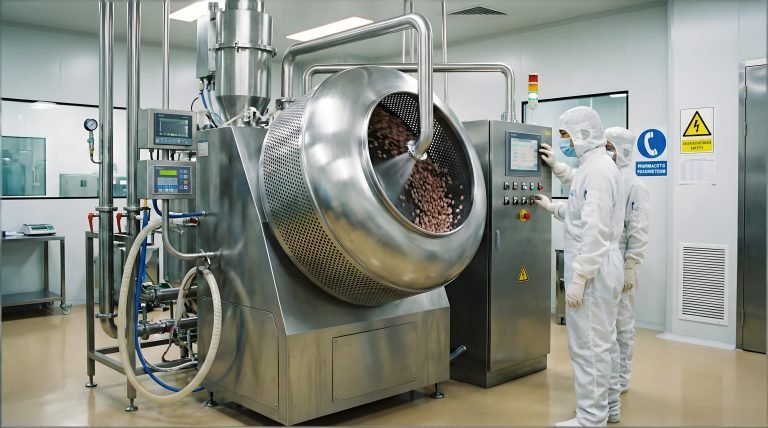
- Perforated Pan Coater: Drum wall has holes. It rotates along a horizontal axis inside a sealed housing. Hot air passes directly through the tablet bed. Much less energy loss.
Key differences:
1. Shorter Drying Path: Air Goes Straight Through
- Perforated pan: Hot air gets pulled directly through the tablet bed. Exits through drum holes. Heat transfer is concentrated. Drying is extremely efficient.
- Solid pan: Hot air enters from the front. Swirls chaotically inside. Then exits through an exhaust. Very little energy actually hits the tablets.
Result? Perforated pans consistently deliver faster drying and better heat exchange.
2. Controllable Airflow, Stable Spray Zone
Popular perforated designs (Hi-Coater, Accela-Cota, Driacoater, Glatt) focus on engineered airflow paths:
- Accela-Cota / Hi-Coater: Drying air passes horizontally through the tablet bed. Exits through drum holes. Balances drying and spray zone stability.
- Driacoater: Hot air enters through hollow ribs built into the drum wall. As it rotates, it acts like “hot air blades inserted into the tablet bed.” Creates localized fluidization.
- Glatt Coater: Fully perforated drum with airflow guides. Air can pass from inside to outside. Zoned air chambers enable partial fluidization and multiple airflow combinations.
This means: Spray zone temperature, humidity, and turbulence can be engineered and replicated. No more relying on operator experience and “eyeballing it.”
3. Better Fit for Aqueous Coating and Environmental Compliance
Perforated pans became widespread due to three real pressures:
- Organic solvents are volatile and explosive. Post-1980s, explosion-proofing requirements surged.
- VOC emissions face strict environmental regulations. Treatment costs keep rising.
- Industry shifted from organic to aqueous coatings. Water evaporation demands higher heat loads and better drying paths.
Perforated design enables:
- Significantly higher evaporation efficiency. Shorter aqueous coating times.
- Reduced total solvent use and residuals.
- Easier explosion-proofing, solvent recovery, and exhaust treatment inside sealed housings.
Put simply: Regulations, safety, environment, and cost all pushed it onto the throne.
4. Better Automation and Scale-Up Reproducibility
Perforated pans naturally support:
- Closed-loop control of inlet/exhaust temperature and humidity.
- Precise control of spray rate, speed, and droplet size.
- Online monitoring via pressure differential and exhaust humidity.
- Automated cleaning (WIP/CIP) and cleaning validation.
For R&D: Scale-up becomes engineered. No more relying on “master craftsman intuition.”
For quality: Batch-to-batch coating weight, film thickness, and dissolution curves become controllable.
Industry Trend Forecast: It’s a “Must-Have” Over the Next Decade
Looking 5–10 years ahead, here’s my prediction:
1. New or major renovation projects: Perforated pans are practically mandatory.
- Whether it’s aqueous film coating, controlled-release, or enteric coating—perforated is standard.
- Any organic solvent work (IPA, ethanol, DCM) faces tightening regulations. Nobody wants explosion-proofing headaches on solid pans.
2. Solid pans will become increasingly marginalized. Only two use cases remain:
- Small batches, legacy products, traditional sugar coating where appearance matters but efficiency doesn’t.
- Teaching demos, basic training, or extremely budget-constrained small factories.
3. High-end solid dosage processes are tightly bound to perforated pans.
- Extended-release, osmotic pump tablets, functional coated granules: Highly sensitive to film uniformity and dissolution reproducibility. Without stable drying environments, fine control is impossible.
- High-potency APIs: Requirements for “sealed housing + negative pressure / isolator connections” can only be perfectly achieved in perforated systems.
Bottom line: It’s not about “whether to adopt” perforated pans. It’s about “when you’ll be forced to.”
What Does This Mean? Real Impact on Companies and Individuals
For Process Development: Experience Era Ends. “Airflow Design” Becomes Core
Old approach to coating development: “Try 3 rpm, 45°C inlet, spray 2 hours, see how tablets look, then adjust.” Many processes depended on senior operators. Nobody could explain why it worked.
With perforated pans, the logic shifts:
- First, clarify: Where does air enter? Where does it exit? What’s the tablet bed density? Where’s the spray zone?
- Drum speed, gas-solid ratio, bed thickness, inlet temperature/humidity—all need defined target ranges.
“Airflow + thermal engineering” shifts from supporting condition to core process variable. Whoever explains this logic clearly becomes the key process engineer.
For Quality and Regulatory: One Unstable Batch Puts the Whole Line Under Scrutiny
Perforated pans typically handle:
- Core product lines;
- Functional film coatings with dissolution requirements;
- Export projects or bioequivalence (BE) studies.
When coating problems arise, appearance defects (color variation, spray spots, orange peel, sticking) are surface wounds. The real killers: content uniformity failures, dissolution anomalies, stability degradation.
Regulators and customers don’t care which pan you use. They care about results. But reality is: Once you use perforated pans, expectations for product consistency go higher. QA/regulatory teams must clearly define design space (airflow, temperature, speed) and scale-up principles in submissions.
For Equipment Investment and Capacity: Calculate More Carefully
Perforated pans cost more upfront. That’s fact. But many companies miscalculate long-term total cost. Consider:
- Batch cycle time: Perforated pans typically shorten coating duration significantly.
- First-pass yield: Fewer reworks equals direct cost savings.
- Energy consumption: Higher heat exchange efficiency may mean lower total energy per coating amount.
- Labor: Higher automation turns operators from “manual workers” into “process controllers.”
Practical judgment: If you coat several hundred batches of core products annually, not adopting perforated pans almost guarantees higher unit costs.
What Should You Do?
Strategy One: Don’t Rush Equipment Purchases. Start With a “Process Route Checkup”
Take your 3–5 highest-volume, highest-quality-risk products. Evaluate whether to switch to perforated pans. Entry points:
- Are these aqueous or organic coatings? What’s the aqueous percentage?
- Current coating time? Any capacity bottlenecks?
- Any complaints, returns, or deviation rework in the past year?
- Future bioequivalence studies or international registrations planned?
You’ll find: Some products benefit from perforated pans as “nice-to-have.” Others are “must-change.”
Strategy Two: New Projects Default to Perforated Pans
If you’re launching a new product, especially:
- Planning aqueous film coating, extended-release, or enteric coating;
- Targeting bioequivalence studies or US/EU registration.
Advice is blunt: Develop on perforated pans from R&D stage. Don’t “test on solid pans then migrate.” Migration means another round of development and deviation justification. Solid pans can’t replicate perforated pan dissolution details.
Strategy Three: Don’t Just Buy Equipment. Upgrade Team Capabilities Too
What truly separates winners isn’t the brand. It’s who masters the airflow and thermal logic.
- Training: Engineers should learn gas-solid flow fundamentals (like bed thickness vs. air pressure relationships).
- SOP upgrades: Don’t just write parameters. Explain why you chose that range. What happens to appearance and dissolution if you deviate? New employees need to know what’s adjustable and what’s off-limits.
- Build a “defect gallery”: Link sticking, color variation, roughness, and cracking to parameters (airflow, temperature, spray rate, solids content).
Strategy Four: When Selecting Equipment, Ask Key Questions—Not Sales Pitches
During equipment evaluation, focus on:
- What’s the actual inlet/exhaust airflow path? Does it support multiple airflow mode switches?
- Drum perforation rate and airflow guides: Any special designs for small tablets or capsule jamming prevention?
- Spray gun capability: Number of guns, adjustable angles, auto-cleaning compatibility?
- Cleaning control: True WIP/CIP support? Isolation solutions for high-potency products?
- Scale-up support: Does the vendor provide pilot-to-production scale-up guidance cases?
Ask these questions. You’ll quickly spot who truly understands process versus who just sells equipment.
Summary
Perforated pan coaters aren’t “new technology” anymore. They’re modern solid dosage infrastructure. They solve more than efficiency:
- Feasibility of aqueous coating;
- Process reproducibility and safety compliance;
- Possibility of large-scale automation.
The real gap isn’t the equipment itself. It’s who recognized earlier that this “pan with holes” is the starting point for rebuilding production and process capabilities.
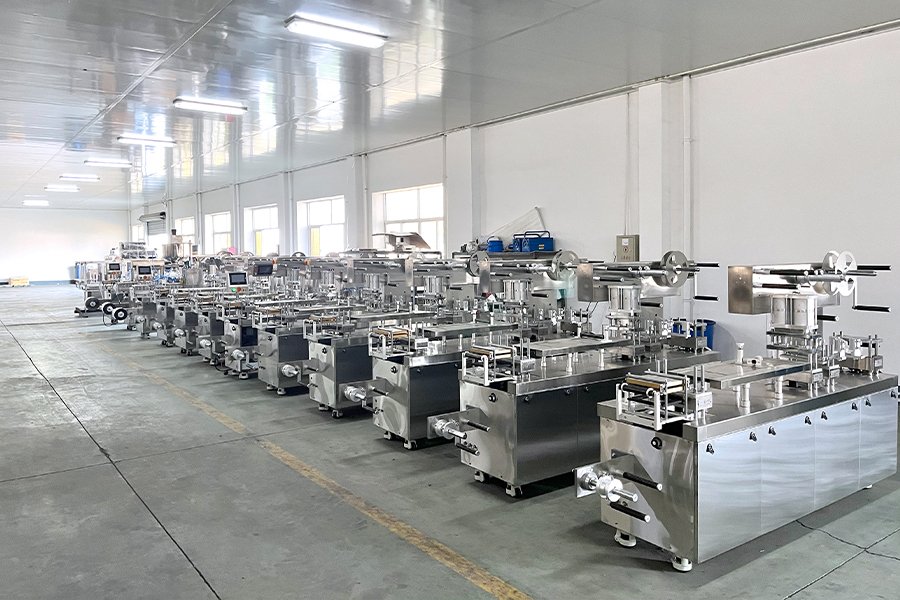
Welcome To Our Pharmaceutical Equipment Line Factory!




Why Choose Us
Specialized Factory
Economical Pricing Options
On-Time Delivery
Perfect Customer Service
Custom Solutions Available
Our technical experts are always ready to assist you in finding the perfect customized solution for your needs.